

Table of Contents |
Whether you’re looking for more control over residential complexes or industrial settings, a smart ring main unit can be the perfect medium voltage switchgear.
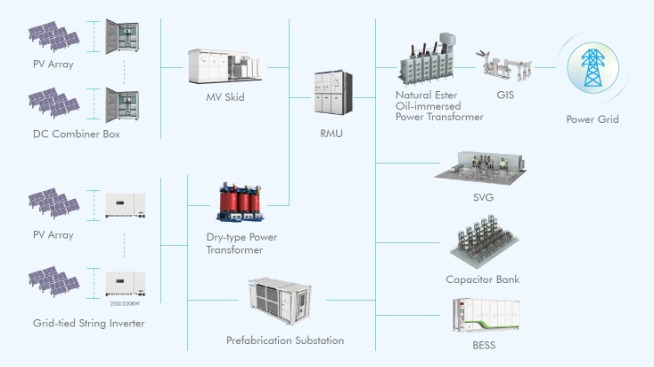
A typical ring main unit, known as an RMU for short, is a medium voltage switchgear that is used in electrical power distribution systems. They provide continuous power with the added ability to switch power sources in the event that a repair or emergency happens. With the newly introduced smart RMU, you can enjoy secure grid connectivity and integrated smart sensors for active system monitoring at all times.
The global smart ring main unit market is projected to reach USD 5 billion by 2035. This growth is driven by the integration of automation in electronic systems, substation automation adoption, industrialization, and a focus on renewable energy installations. Increasing electricity demand and government investments in energy projects further support market expansion.
The Basics of Ring Main Unit
An RMU is a medium voltage cabinet containing input and output cable compartments. It isolates these individual compartments with single breakers connected to cables that go out to transformers. Each compartment has load breakers and protective fuses installed. Smart RMU cabinets come standard in two, four, and six-compartment setups.
Each cabinet will contain different types of switches that can have varying purposes. For example, one switch may feed a distribution transformer while another may connect with a load. These highly compact power distribution units are utilized for medium-voltage power situations. Smart RMUs can be constructed for various configurations, with the 24 kV distribution network being the most commonly used today. It’s important to realize that each cabinet or unit is a completely sealed system.
Each RMU switchgear has three main functions. It controls the circuit to switch functions, isolates faulty equipment from the remaining circuit, and protects the circuit from short-circuit faults, the ground-fault current, as well as overloads.
Thanks to the technology inside of RMUs, they go a long way in reducing power outages and helping you to maintain a constant supply of power.
Types of Ring Main Unit
There are three main types of ring main units that you need to be aware of. These include gas-insulated, air-insulated, and solid-insulated. Each is necessary for its own type of specific application. This is why it’s so imperative that you understand the differences between them so that you can choose the right smart RMU to meet your needs.
Gas-Insulated
Gas-insulated RMUs are a great choice for indoor and outdoor secondary distribution networks. RMUs like Chint Global’s NG7-17.5 provide dependable energy up to 36kV and work to safeguard your electrical equipment at all times. They’re ideal for power plants, industrial zones, transformer substations, etc. Gas-insulated are the most widely utilized RMUs on the market today.
Air-Insulated
Air-insulated RMUs are airtight cabinets whose primary switch is an air-insulated vacuum load switch. These metal enclosures feature very sturdy construction and are made to perform under difficult conditions. They’re great for factories, businesses, high-rise buildings, and residential blocks.
Solid-Insulated
Solid-insulated RMUs are typically constructed with oil as the insulating material. They are specifically designed to withstand corrosive and hard environments. It’s ideal for installations in oil fields and mining environments.
Advantages of Smart RMUs
Smart RMUs are ideal for helping you to manage the various challenges of power distribution. These all-in-one solutions are safe switchgears that are simple to install for various voltages.
They are constructed to withstand harsh environmental conditions and can be placed both indoors and outdoors. These smart RMU systems offer enhanced protection against overload current fault currents, phase-to-phase fault currents, and ground contact currents.
With virtually no maintenance required, these compact units last an average of 20 years. Integrated with internal self-testing features that allow you to know exactly when something is amiss during the commissioning stage, these smart RMUs ensure optimal quality protection. With their equipped smart electronics and communications capabilities, smart RMUs are far superior to traditional RMUs.
Smart RMUs are very simple to integrate with any distribution management system and make Smart Grid solutions a breeze for all operators. Even better, you can enjoy grid connectivity without having to worry about your level of data security. Smart RMUs are both cost and time-effective, which are highly prized traits in the 21st century.
Applications of Smart Ring Main Units
RMUs are utilized in a number of underground cable transmission network applications where medium voltage power distribution is necessary. They’re extremely in demand for those industries that require a continuous and reliable power supply and can afford the higher upfront cost of the unit.
These include residential complexes, business centers, hospitals, resorts, airports, metros, solar power plants, wind power plants, small secondary substations, and so much more. They’re ideal for minimizing downtime, as any interruption in the power supply can be instantaneously replaced with manual or automatic switching.
Chint Global: A Smart RMU Solution
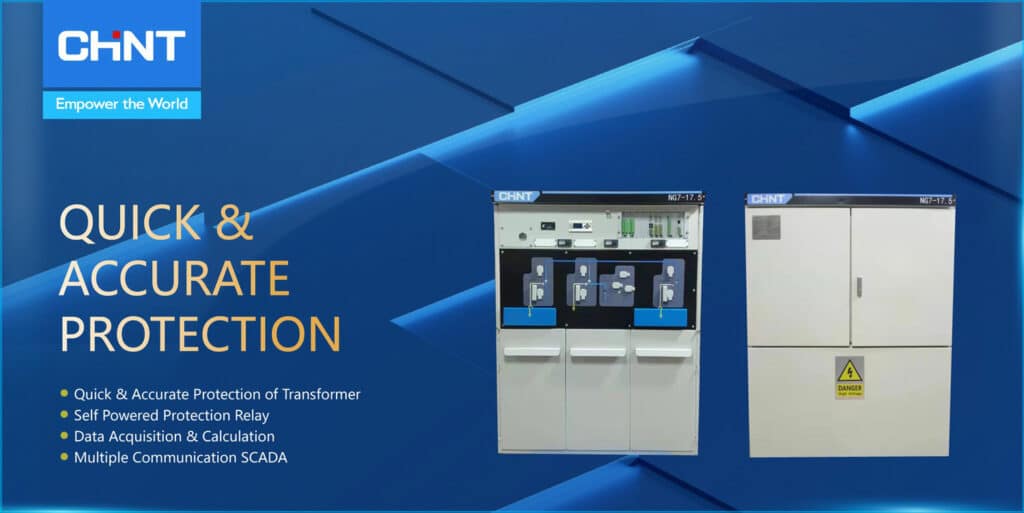
Chint Global currently offers smart ring main units in the NG7-17.5 and NG7-12/24kV models. The NG7-17.5 will provide very quick and precise protection for the transformer. It offers a self-powered protection relay and earth fault indicator. This model features sensors for CT and VT, remote breaker and switch controls, and a very long battery backup period.
The NG7-12/24kV is perfect for power supply lines of between 12 and 40.5kV. This RMU is highly adaptable to your specific operating environment and features a high level of protection. Its compact structure, coupled with its maintenance-free operation, makes it a favorite option for many. This RMU is highly reliable and offers flexible expansion for all of your future power distribution needs.
Conclusion
RMUs are an essential component of any modern-day power distribution supply. They offer the ability to protect the system from overloads and short circuits while being able to supply constant power and the ability to isolate faulty equipment when problems occur. Choose Chint Global for reliable and high-quality smart RMUs to enhance your power infrastructure.
If you have any questions or need further assistance, don't hesitate to reach out to us.
/ng7-12~24-630/product-image/NG7-12~24kV RMU-image-1.png.thumb.319.319.png)
/ng7-12(z)t(1250~3150)/product-image/NG7-40.5(Z)T(1250~3150)-image-1.jpg.thumb.319.319.png)
/sf6/ng7-40-5/product-image/NG7-40.5-RMU-Image-Module.jpg.thumb.319.319.png)
/ngh-12(z)(1250~3150)/product-image/NGH-12(Z)-(C-GIS)-Onsite Image-6.jpg.thumb.319.319.png)