

Introduction
An electromagnetic starter is not selected by motor power alone. In an OEM control panel, the starter must match the motor’s duty, coordinate with the panel’s protection, fit the control circuit, and suit the machine’s enclosure and mounting. A three-phase electromagnetic starter—often described as a 3 phase magnetic starter—can be a practical choice for direct-on-line control, provided the motor and supply can tolerate full-voltage starting.
CHINT’s NXQ series is one direct-on-line example. The catalog combines an AC contactor with a thermal overload relay, while CHINT’s product page and catalog summary differ on headline current and enclosure ratings. For a production design, use model-specific ratings and confirm the ordered configuration. The checks below help OEM engineers make that decision before releasing drawings and bills of materials.
What Does an Electromagnetic Starter Do in an OEM Panel?
A motor starter switches power to a motor through a contactor and, in many assemblies, adds thermal overload protection. When the control circuit energizes the contactor coil, the magnetic field closes the main contacts and applies full line voltage to the motor. Opening the control circuit de-energizes the coil; the main contacts open and the motor stops.
That direct-on-line arrangement is straightforward, but it subjects the motor to its full starting current and torque profile. The application’s supply, driven load, and mechanical system must accommodate that start. A starter assembly is also more than a standalone contactor when it includes an overload relay or operator controls. Check the exact model: features such as overload and phase-failure protection are not universal across every starter.
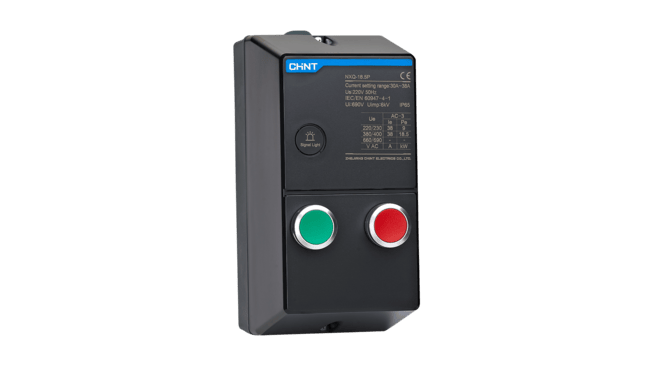
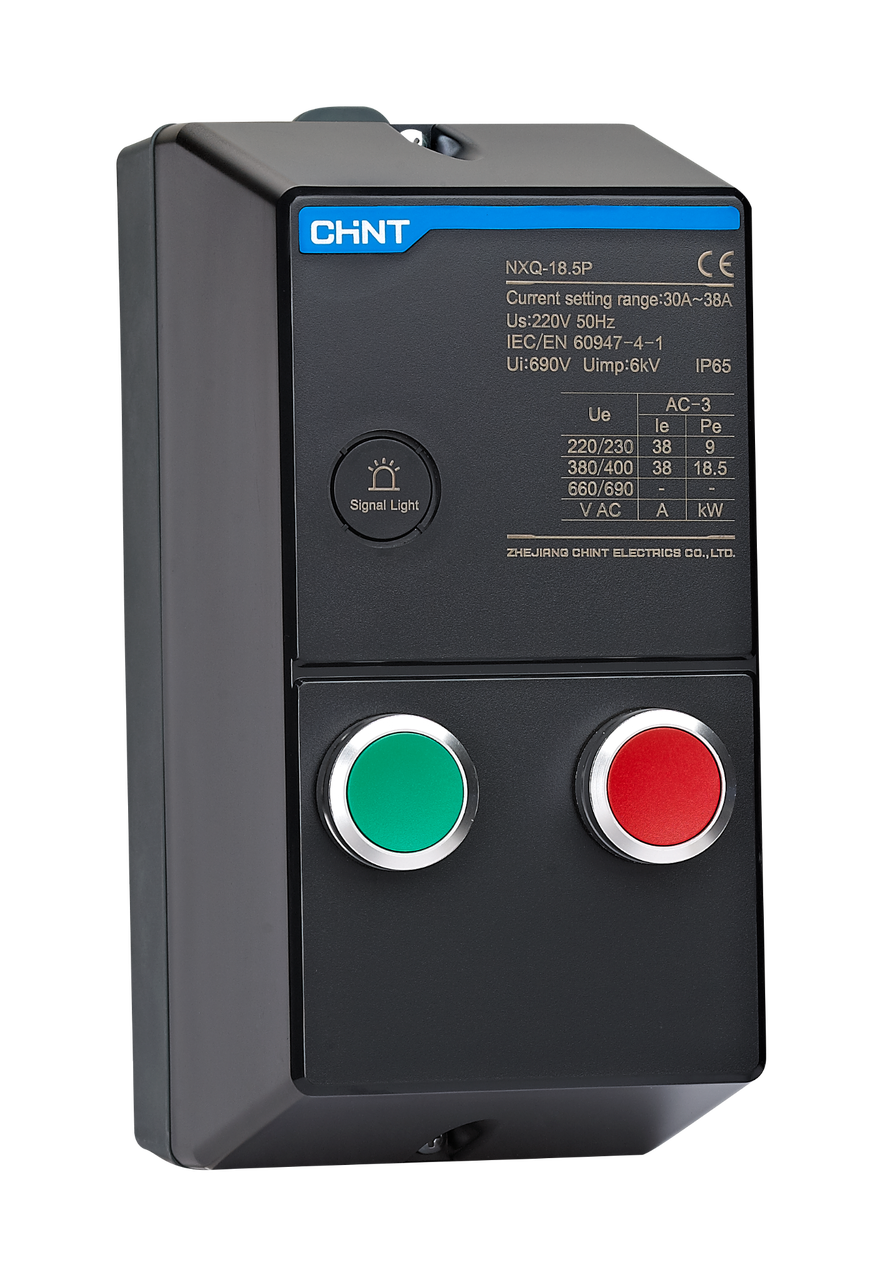
CHINT lists the NXQ as a direct-on-line electromagnetic starter for motor start/stop control. Its catalog identifies an integrated thermal overload relay for overload and phase-failure protection. This is useful for an OEM comparing a 3 phase motor starter with overload protection, but those functions do not replace the branch circuit’s short-circuit protective device.
How Do You Match Starter Ratings to the Motor and Duty?
Start with the motor nameplate and operating conditions. Record rated voltage, phase, frequency, full-load current, and motor power, then confirm the supply and load characteristics at the machine. Select the starter against the motor’s operating current and the applicable AC-3 rating at the actual voltage. The same motor power can correspond to different currents as voltage, efficiency, and motor design change.
Do not apply a series maximum to every model. CHINT’s product page lists NXQ rated current from 9 A to 95 A under AC-3, while the May 2025 catalog summary gives a series maximum of 100 A and controlled power up to 45 kW. The model tables show ratings by starter size and supply voltage. Because the headline figures differ, specify the selected model’s table value at the intended voltage and duty, and confirm the model suffix before procurement.
AC-3 is the utilization category to check for typical starting and switching of squirrel-cage induction motors. Also review starting frequency, load inertia, expected operating hours, ambient temperature, and the machine’s start cycle. A pump that starts occasionally presents a different duty from a conveyor that cycles repeatedly under load. If the motor takes a long time to accelerate or the supply dips during start, consult the motor and starter manufacturers before treating a standard DOL rating as suitable. For broader application context, the U.S. Department of Energy’s motor-systems guidance emphasizes evaluating motors and driven equipment as a system.
An electric motor starter sizing chart can help screen candidate ratings, but it cannot approve a design on its own. Use the exact model’s current, power, voltage, overload adjustment range, and published application conditions. For IEC magnetic motor starters, verify the stated utilization category and rated operational current rather than relying on a catalog headline or a keyword-level product description.
How Should OEMs Coordinate Overload, Phase-Failure, and Short-Circuit Protection?
Overload, phase failure, and short circuit are separate conditions. The NXQ catalog describes the integrated thermal relay as protecting against motor overload and phase failure. Set its current adjustment according to the motor nameplate and the relay instructions. Confirm that the setting range includes the motor’s required value and that the relay’s trip behavior is compatible with the motor’s normal starting time.
Short-circuit protection must be coordinated upstream. Select the circuit-breaker or fuse with regard to the available fault current, the protective device’s interrupting rating, conductor protection, and the starter’s published short-circuit coordination data. A breaker’s current rating alone does not show that the breaker, starter, and panel assembly have been coordinated as a combination. Check the manufacturer’s tested combination tables and the installation’s fault-current study.
Use the relevant equipment standards as part of the specification: IEC 60947-4-1 covers electromechanical contactors and motor-starters, while IEC 60947-2 covers circuit-breakers. Standards references do not replace project-specific coordination, applicable local codes, or the model documentation. A 3 phase motor starter with overload protection still needs a separately verified short-circuit protection scheme.
What Enclosure, Control, and Mounting Options Should Panel Designers Check?
Fit the starter to the panel layout before the enclosure design is released. Verify overall dimensions, service access, cable entry, conductor space, heat dissipation, and clearance around adjacent devices. CHINT’s NXQ catalog describes external or internal mounting holes and requires vertical installation. It also uses knock-out wiring holes; the manual calls for suitable waterproof cable entries and sealing hardware to maintain the enclosure rating.
Check the protection rating against the exact enclosure variant and installation. CHINT’s May 2025 catalog lists IP65 for NXQ-5.5 through NXQ-18.5 and IP55 for NXQ-22 through NXQ-45. The current product page separately lists IP40 for the standard enclosure, with higher protection on request. These published statements do not establish the rating of every orderable variant. Confirm the exact model and enclosure rating with CHINT before placing it in the specification, especially where water, dust, washdown, or outdoor exposure is possible.
Operator choices also affect how the machine is used and serviced. The catalog provides versions without buttons, with reset only, with a start button and combined stop/reset button, and with separate start, stop, and reset buttons; indicator-light versions are available for some arrangements. CHINT states that the combined stop/reset button is not suitable for frequent operation, whereas a separate stop button is suitable for frequent operation. Match the button code to the machine’s cycle and operator workflow.
Confirm control-circuit voltage, coil requirements, auxiliary contacts, interlocks, and wiring against the OEM schematic. CHINT lists 24 V, 110 V, 220 V, 380 V, and 415 V AC control-voltage options, but availability depends on the model. Its manual notes that the control circuit is factory-wired on the assumption that its voltage matches the main circuit. If a different control supply is needed, follow the wiring diagram for the exact model rather than assuming the factory connections can remain unchanged.
The catalog also describes an internal quick-connect plug for the control circuit. Treat this as an assembly and service feature; it does not remove the need to verify the main-circuit wiring, grounding, cable terminations, overload setting, and commissioning checks. A motor starter enclosure should be selected as part of the cabinet and installation design, not by its IP number in isolation. For U.S. workplaces, OSHA’s lockout/tagout standard addresses hazardous-energy control during machine servicing and maintenance.

When Should an OEM Consider a Soft Starter or VFD Instead?
Use a direct-on-line electromagnetic starter when full-voltage starting suits the motor, load, supply, and mechanical system, and the machine needs straightforward start/stop control. If the starting current or mechanical shock needs to be reduced, a soft starter such as CHINT’s NJR5-ZX may offer a controlled starting or stopping ramp, subject to the model’s ratings and the load requirements.
A soft starter does not provide continuous speed regulation. Where the process needs adjustable motor speed, controlled torque across the operating range, or speed-based process control, assess a variable frequency drive such as CHINT’s NVF7. Drives change the motor-control architecture and require their own motor, protection, wiring, and thermal checks. Neither alternative is automatically a better fit; select by the machine’s operating requirements.
A 5-Point Starter Selection Check Before Design Release
- Record the motor nameplate data, supply voltage, load, and expected start cycle.
- Match the model’s AC-3 current and power rating to the actual voltage and motor duty.
- Set overload protection from the motor data and coordinate short-circuit protection upstream.
- Confirm enclosure variant, button arrangement, control voltage, mounting, cable entry, and service clearance.
- Record the model code, wiring diagram, coordination data, applicable certificates, and manufacturer confirmation in the panel design file.
Keep the electric motor starter sizing chart as a selection aid. Final approval should follow the exact model data and coordinated panel design.
Conclusion
Reliable starter selection connects the motor nameplate to the panel design. Confirm the AC-3 rating and overload setting at the intended voltage, coordinate short-circuit protection separately, and verify control, enclosure, mounting, and operator requirements against the selected model. CHINT’s NXQ can suit OEM panels where the exact configuration matches the application; model-level documentation should resolve the series-wide differences in published ratings before procurement.
FAQs
Does the NXQ support remote start and stop?
CHINT’s product page lists manual start and automatic or remote stop. It does not establish that every NXQ configuration supports remote start. Confirm the required start/stop circuit, control supply, and terminals against the selected model’s wiring diagram.
Can the NXQ be used with a single-phase motor?
The NXQ catalog is written for motor-control circuits and shows three-phase wiring diagrams. It notes a specific arrangement for single-phase motors using two main-circuit phases in series. Treat that as a model-specific wiring condition, not a general single-phase compatibility claim; use CHINT’s diagram and have the application checked by a qualified electrical designer.
What installation conditions does CHINT specify for the NXQ?
The catalog lists an ambient range of −5°C to +40°C, altitude up to 2,000 m, and humidity limits tied to temperature. It also specifies vertical installation and protection from rain and snow. Check the full installation conditions in the current manual when the panel will operate outside those limits.
Can the NXQ control circuit use a different voltage from the main circuit?
Yes, if the selected model and its wiring arrangement support the required control voltage. CHINT’s manual says the factory wiring assumes control and main-circuit voltages match; where they differ, the control wiring must be changed according to the model-specific diagram and connected to the appropriate supply. Do not rely on a generic wiring description for the final panel.