


Table of Contents |
Homes have been safeguarded by electric fuses from high electron flow and circuit temperature rises. They are still common in older residences and frequently meet building codes. Are you interested in knowing more about electric fuses and how they work? Good, continue reading and we’ll give you all you need to understand about electric fuses.
What's an Electric Fuse?
A fuse box is a small metal box that serves as the electrical system’s central node, dividing incoming voltage into its many circuits. It’s sometimes referred to as the main switchboard, breaker panel, or circuit board, and powers all of your home’s and office’s electrical systems.
It has cartridge fuses and screw-in fuses in the range of six to twelve. Ancient fuse boards had a total capacity of 60 amps. However, the majority of modern domestic electrical systems can handle 200 amps in total.
How Do Fuses work?
According to the National Electrical Code, a fuse is considered an Overcurrent Protective Device (OCPD). A fusible portion, or component that can melt, is required for one fuse to function effectively. This is a glass fuse body with a metal ring sealed inside it; it is referred to as a fusing element.
The fuse element heats up and melts when it absorbs more energy than it can manage. The circuit breaks, indicating that it is complete and secure. The fuse must be replaced with a new one after this occurs.
What Differentiates a Circuit Breaker from a Fuse?
A Fuse is frequently grouped with a circuit breaker because it can be used as an OCPD. However, they aren’t the same products! The primary distinction between a circuit breaker and a fuse is that the circuit breaker can be re-used while the fuse cannot. Fuses guard your house and equipment against overload. The home is safeguarded by circuit breakers against overloading and short circuits.
What Are The Various Fuse Types?
The proper fuse box will protect your home from fires and other damage. There are now three types of fuses available:
- Type-S (Rejection base) These fuses come with a fuse and an adaptor that may be inserted into an Edison-style socket.
- Fuses with the Type-T (Edison base) designation are the norm for practically all 120 to 125-volt domestic circuits.
- Cartridge Fuses: The fuses are used to control the power of the fuse box and are used for 240-volt appliance circuits.
How Can A Fuse Be Replaced In A Fuse Box?
You will need tools like electrical testing equipment, a multimeter or a coherence test, a headlight, a screw-in fuse replacement, and a cartridge fuse backup to replace a fuse in a fuse box.
How Come Fuses Blow?
Fuses may blow for several causes, including:
- When a high-volume current travels via a low-resistance electrical route, a short circuit is created. Electric cables can be pierced by a nail or screw, allowing water to enter the input jack and resulting in a short circuit. They can burn metal, start fires in arches, harm wire insulation, and evaporate conductors since they are a thousand times stronger than the average current.
- The electric fuse blows due to a ground fault that occurs when a charged hot wire meets something grounded, such as a metal pipe, power box, your palm, bare neutral wire, or an outlet.
- The circuit may open and the fuse may blow because of an electric overload that’s also six times the average current flow. When there are too many devices plugged into one circuit, overloads typically occur.
How Can I Tell If A Fuse Is Blown?
You can determine whether a circuit has blown visually or using the aid of a tool known as a continuity tester or ohmmeter.
Visual testing will allow you to determine whether the fusing component inside the fuse box has been severed and if the pane of glass on screw-in fuses is clear. Due to the melting fusing ingredient, it could seem brown, hazy, or black.
Testing Instrument: You can measure resistance with instruments like ohmmeters and continuity testers. Keep one test lead attached to the fuse’s end and the other to the screwed side when inspecting a screw-in fuse. To determine whether current is flowing further through the fuse for such a cartridge fuse, hold the check leads at the fuse’s opposite ends.
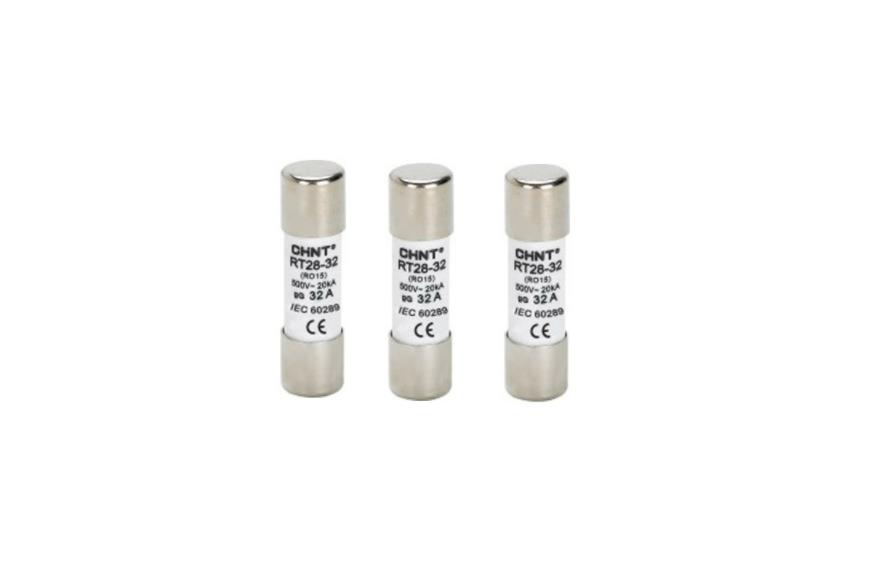
CHINT Electrical Fuse
RT28 Fuse Disconnector
Electric ratings for the RT28 Fuse Disconnector are AC 380V/500V, up to 125A. Used to safeguard power distribution equipment from overload and short circuits. The fuse disconnector’s fuse indication equipment (code “X”) is made up of a neon bulb and resistance; The IEC 60269 standard.
RT36 Kinfe Contact Fuse Protector
Electric rating: AC690V, up to 1000A; Application, To safeguard the electrical device from overload and short circuit; Specifications: A small size, light-weight, limited power requirement, and excellent breaking strength; The IEC 60269 standard.
Conclusion
The overflow of electricity can harm your devices and even threaten human lives due to electric fire. Therefore it’s non-negotiable that you get a suitable device (either fuse or circuit breaker) installed in your home to secure it against anything that goes wrong with electricity. And it would be best to make that choice with the help of a qualified and experienced electrician.