

Table of Contents |
Off grid solar system are on-trend nowadays because they can save you lots of money. You won’t worry about paying your electricity bills every month if you have an off-grid solar power system that can handle your power consumption.
So in case you want to try how efficient it is, you can build one with only the right help for experts. Let’s get to the details.
What is off grid solar system?
It is also known as a stand-alone system for power or energy consumption. It is an independent power source to which a consumer is directly connected. Although the consumer would spend more in purchasing the materials needed, it can save them from monthly costs for a long time.
Basically, this gets power from the sunlight, and it will use some of the excess energy collected from it during the day for the night because of the batteries.
The best off grid solar system is made efficient even though a place has frequent power shortages. This means that it is best to use in rural and remote areas where electricity is not that abundant.
How to build an off grid solar system?
Unlike our wire electricity connection, we don’t really calculate our loads or appliances usage before purchasing them. And the reason is we know our power source can handle it. However, this is not the case in using off-grid solar.
For example, a 100-watt solar panel can light a 100-watt bulb load for three nights. But for that to happen, you need at least 1600 watt-hour of daylight. Otherwise, it won’t charge your batteries.
Please take note that it is not solar power that makes the bulb lit up. The solar charge your battery, and the battery distributes the power. If you use them during rainy days, you should use a battery with high storage and an additional panel. And that is because, on rainy days, they won’t be able to store power that much.
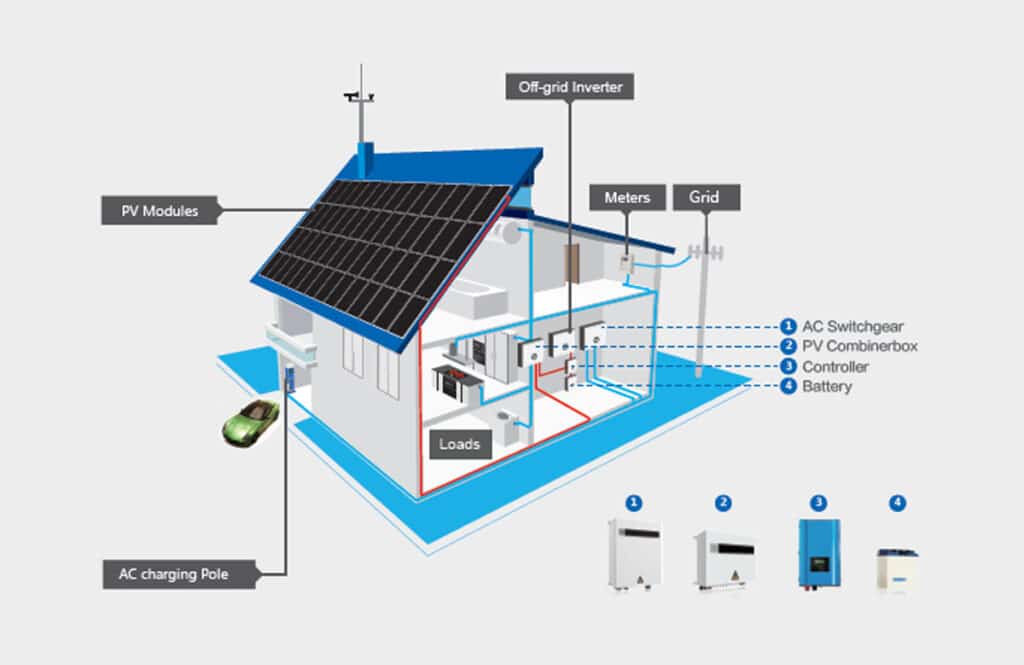
Our appliances run using AC or Alternating Current. In comparison, solar produces a DC or Direct Current, and we need to convert it to AC to use it. This is why we need a solar inverter. You can have it attached directly to your panel, but there is also an inverter between your panel and the batteries.
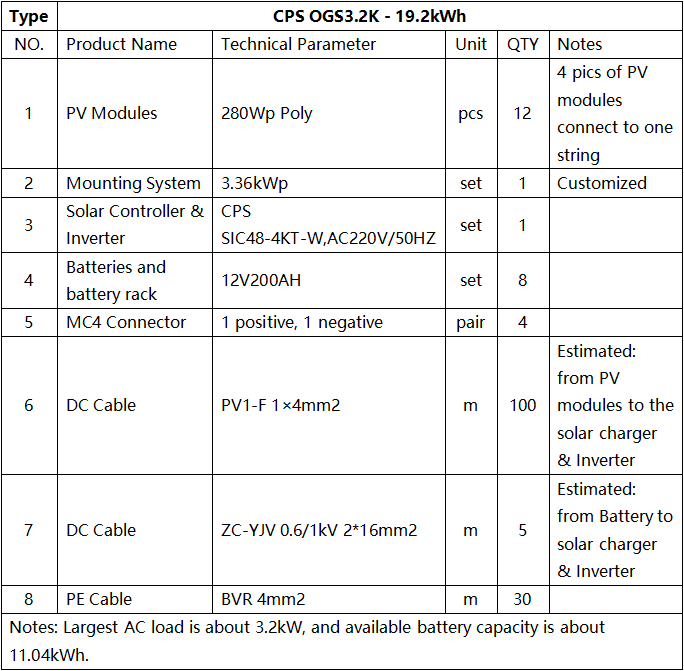
To sum it up, you need the following for your off grid solar system packages:
- Solar Panel
- Batteries
- Wires / Switchboard
- Charge controller
- Inverter
- Generator
In case your battery is already running empty, you have the option to get a generator. You can use this using cloudy or rainy days to back up your power source. Its size is measured by kVA, which is enough to supply power to your batteries. However, this is only optional.
How much does an off grid solar system cost?
An off grid solar system costs a lot, depending on the materials you will use. Below is the average cost of each material for your reference:
- SOLAR PANELS – $5,000 – $30,000
- HYBRID INVERTER – $3000 – $13,000
- BATTERY BANK – $10,000 – $30,000
The overall cost of your off grid system will really come down to the size and type you have installed. Obviously, the larger, the higher capacity, the more expensive the material could be.
Nevertheless, you can’t really avoid it, especially if you have a lot of appliances at home. For this reason, you must seek advice from someone well-versed in solar power before you purchase or make your own.
On-Grid Solar Power Systems vs. Off Grid Solar Power Systems
The difference is technically their connection. As mentioned, an off-grid system is independent while an on-grid is not.
On grid solar system is connected to a nearby or local utility’s GRID. This is common in residential homes designed to use a solar system. The residents are also maintaining the GRID. The advantage of residing in this area is that they have access to generators on a large scale.
This means that if there is a power emergency, they would still be able to use energy. However, the disadvantage is that everyone is negatively affected if there is a problem with the main source. If you use an off grid solar system, you won’t experience such unless your source alone has a problem.
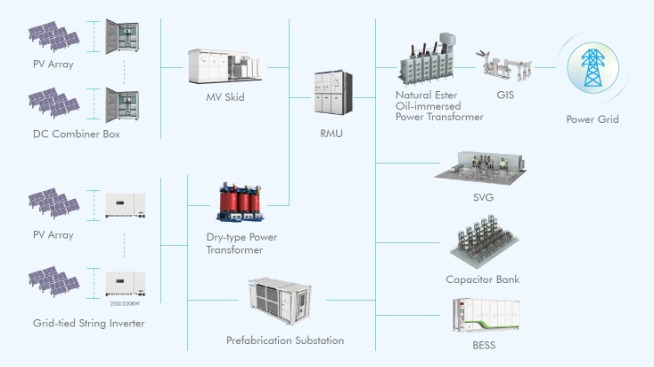
CHINT Off grid PV Solutions
CHINT off grid PV solutions feature high-quality materials that would help you get your desired off-grid solar system.
Their PV solutions and solars are used in remotes areas and in farming and industrial fields. They sell three types of solar panels. The BlackSerie and Monocrystalline that has more than 19% of module efficiency. In addition, they have Ploycrystalline with 18.5% module efficiency.
The module efficiency available as of today is only between 15 – 18%. This proves the quality of CHINT products!
Moreover, they offer a controller with MPPT technology. Having this type of controller maximizes the use of your solar panel. This makes a high power conversion of the solar energy securing 95% of system efficiency.
It is not new for energy to get wasted as they get transferred from one place to another, so having a piece of equipment that can help you use much more is a practical choice. Moreover, their controller has an alarm function.
This means that if the battery is dropping low, you will get informed immediately and have enough time to power the generator to avoid draining the battery. Because once the battery is depleted, there is a high chance it will decrease its capacity, especially if the battery does not have the right quality.
Furthermore, they also sell an off grid inverter suitable for most electrical appliances. Some appliances are sensitive and won’t power on when connected to an inverter. But this won’t be the case with CHINT off-grid inverter. It could work even in high altitude and harsh environments.
Conclusion
Overall, having the best off grid solar system is a significant investment whether you live in urban or rural areas. It can help you get power-ready in a bad climate where electricity is usually cut off. For affordable off-grid solar system packages, you can check out CHINT products!