

Table of Contents |
Households and industrial establishments can now benefit from two or more energy sources to power up their equipment – in addition to the “normal” utility power provided through transmission lines. However, an automatic transfer switch lets you take full advantage of these setups and helps you cope with electrical grid shortcomings more efficiently.
What is an Automatic Transfer Switch?
An Automatic Transfer Switch (ATS) is a “smart” microprocessor-driven instrument that, as its name suggests, shifts from one power source to another for continuous energy delivery. This guarantees that your appliances will not shut down whenever there is a power outage in your area.
You’ll find a wide range of ATS panels on the market. Nevertheless, the one you choose to install would have to be suitable for your daily energy needs.
Some ATS systems are specifically designed to feed uninterrupted power (closed transition ATS) in situations where even short blackouts could prove disastrous for adequate service provision (e.g., healthcare). Others allow for short second-long delays (open transition ATS) or even to run two sources in parallel if you require a power boost (soft loading ATS).
Furthermore, you may install your ATS for a myriad of arrangements, whether the setup comprises two power sources (utility-generator, utility-utility, and generator-generator) or three (utility-generator-generator and utility-utility-generator) in more critical sectors.
It bears stressing that the gadget is controlled via a dedicated automatic controller. For that reason, it’s capable of operating without human intervention. Nevertheless, it will only work if installed and programmed correctly by qualified personnel or knowledgeable individuals.
Why Do I Need an Automatic Transfer Switch?
You may want to install an Automatic Transfer Switch on your premises if you need a non-stop power-yielding mechanism that can operate without your input.
This is a particularly handy asset for people who live in areas where the power grid is vulnerable to failure. Whenever you experience brownouts or energy shortages, you’d want a dependable failsafe that can get you through the most demanding and stressful situations,
Needless to say, an automatic transfer switch does not cover the need for an alternative power generator. Notwithstanding, as long as you have a working replacement for your utility provider, an ATS removes the need to manually activate it (while it also gives you the option to do it yourself, all things considered).
It’s hard to deny some of the benefits of manual transfer switches (primarily as it concerns cost-effectiveness), but, alas, these will not save you from damages inflicted by sudden electricity cuts, hence the importance of having a reliable automated mechanism.
How Does the Automatic Transfer Switch Work?
The “control logic” (the “brain”) implemented in the ATS system monitors the voltage and frequency of the energy sources connected to the device. As a rule of thumb, the switch always tends to default to the utility connection. It triggers the alternate generator (which is prone to have more limited fuel and capacity) only when the power line stops sending signals. The process can be summarized thus:
- The primary power source fluctuates and fails.
- The device switches the load over to the alternative (emergency) power source in accordance with its predefined voltage settings.
- The ATS stops feeding from the emergency generator once the utility line gets restored.
If the ATS transition type is closed, the processor will operate on a “make-before-break” basis. Hence, the transfer to the secondary source would occur before the device switches off its connection with the first. That way, the appliances and gadgets connected to the load would not experience any gaps or significant decline in performance.
Many of these devices, such as the NZ7 Automatic Transfer Switching Equipment, come equipped with a LED digital interface that (among other things) allows you to manually adjust and fine-tune transfer value and delay time, as well as check the device and connection statuses.
Automatic Transfer Switch Installation
The installation is usually done near the structure’s main electrical panel.
The installer must make sure that the supplies’ MCBs (miniature circuit breakers) are in the OFF position before continuing. Also, they must confirm that the color-coded cables match so as not to witness any glitches or malfunctions in the mechanism.
With that said, this is how the installation usually transpires:
- The ATS has three sets of terminals: two of them are for the supply lines (“main” and “generator”) and one for the “output” or “load”
- From the MCBs, the wires are connected to the source terminals on the ATS. Phase wires are fastened to the R slots, while neutral cables go into the N slots.
- Phase and live wires are then attached from the output terminals to the N and R terminals on the breakers in the distribution box – the single-pole/double-pole MCBs and the RCCB (Residual Current Circuit Breaker).
Automatic Transfer Switch Diagram
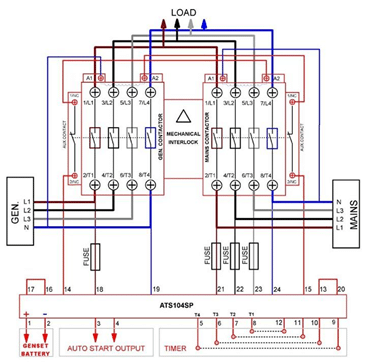
An ATS regularly comes with two main hardware switches:
- The “Auto/Manual” switch essentially instructs the device to either perform the changeover or remain idle and allow the user to “call the shots.”
- Then, on older models, you can find the more oversized switch handle sitting prominently near the center of the device or in a very visible location. When the gadget is set to “Auto,” the switch will turn toward the power source that the load will utilize. In most instances, N indicates “Normal Power” and R “Emergency Power.”
Some devices are handled via a digital panel, with LED lights indicating which supply is powering the locale or structure. As noted earlier, from there, you can control a plethora of aspects and tweak values – such as over- and under-voltage thresholds – as you see fit.
Is a Transfer Switch Worth It?
An automatic transfer switch (for a generator or a similar emergency power supply) is not just a convenience or quality-of-life feature you can enjoy within your home or establishment. Over time, it has turned into a necessity, especially amid energetic uncertainty.
Getting your hands on high-quality automatic transfer switching equipment is a must if your business deals with sensitive equipment that could go awry with minimal power blinks. Life-and-death situations could hinge upon having proper ATS connected to your electrical installations and supplies.
An ATS device is a priceless companion for home appliances for household usage. During a dishwasher or dryer cycle, a voltage drop can be a real nuisance. A trusty ATS can also save you from headache-inducing PC issues due to sudden shutdowns, including data loss and hard disk/RAM failures.
Manual switches are just not a viable solution anymore. This is true for most energy uses, but even more for power users!
Conclusion
The reasons outlined above should hint at the urgency of having an ATS installed in your living and working spaces. Not only would that save you from long and tedious walks toward your electrical panel, but it can also save lives (quite literally!). Be sure to transform your home or business into an energy haven by securing it with a top-notch Chint Global ATS at a very affordable price!