


Table of Contents |
An air circuit breaker is an electrical device that protects your equipment. It offers short circuit and over current protection for electrical circuits over 800 to 10K amps. One of the best brands of air circuit breakers is the CHINT which provides efficient circuit breakers that can make, break and carry high rated current in the circuit. It also protects equipment during power overload, short circuits or even under voltage.
What Is an Air Circuit Breaker?
The air circuit breaker working principle differs slightly from other kinds of circuit breakers . The basic function of any circuit breaker is to stop the restoration arcing when there is a disconnection between the contacts that resists the recovery of the system’s voltage.
That is also what the air circuit breaker will do the same thing, but it works differently. The air circuit breaker operates with its contacts in the free air. They are mainly used for low voltage interruption, and they are becoming more popular and replacing high voltage oil breakers.
An air circuit breaker switches the devices which can turn on, carry and break the current under normal circuit conditions. It also helps to break the current under certain abnormal circuit conditions. The main purpose is to distribute electric energy and protect lines and power supply equipment during overloads, short circuits and under voltage.
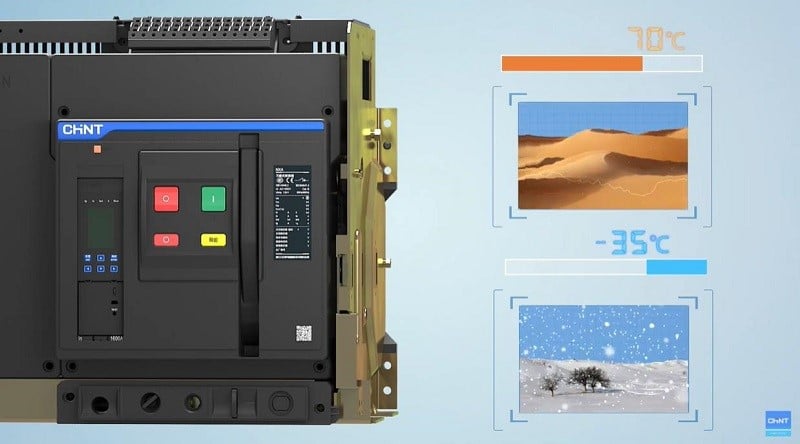
Where Are Air Circuit Breakers Used?
Air circuit breakers are mainly in use for controlling power stations and industrial plants. The reason is that they are good at controlling low voltage equipment. Therefore, they can offer protection to industrial plants, capacitors, electrical machines and generators.
These circuit breakers are used in places with a high possibility of fire or explosion hazards in most cases. There are three different types of air circuit breakers. These are the basic break type of air circuit breaker, magnetic blowout type of air circuit breaker and the air chute circuit breaker.
Plain Brake Type
Plain break type of air circuit breaker is the simplest form of a circuit breaker. The device has two horns with the arc circuit breaker extending from one tip-top to the other.
Magnetic Blowout
The magnetic blowout type of air breakers is used in voltages with a capacity of 11KV. It uses the extension of the arc to get magnetic fields provided by the current whenever there is a blowout coil.
Air Chute Air Break Circuit Breaker
This kind of air circuit breaker has the main contacts made of copper and conducts current in closed positions. One notable factor with air chute circuit breakers is the low contact resistance and silver plating. In addition, it has a solid arcing contact, resistant to heat and is made of copper alloy.
How Does Air Circuit Breaker Work
You can operate an air circuit breaker either manually or through an electrical conversion. What happens is that the free tipping of the air circuit breaker locks the main contact in the closed position when the main contact is in a closed state.
The main circuit is connected to the coil of the overcurrent tripper and the thermal element of the thermal tripper. The current air trippers have an aluminum single plate of curtain wall material; with a high aluminum alloy plate. The coil of the device that is the under-voltage trip is connected parallel to the power supply.
The insulated plate is then mounted with left and right-side panels and also with instantaneous overcurrent trip. The upper part of this device is equipped with an arc extinguishing system. The operation mechanism is installed directly on either side or in front and the manual disconnection button.
What Is the Difference Between VCB and ACB?
The VCB or vacuum circuit breaker is slightly different from the ACB or the air circuit breaker in several ways. A vacuum circuit breaker is a device where the arc quenching takes place in a vacuum medium. The switching on and closing of the current-carrying contacts and the interrelated arc interruption happens in a vacuum.
VCB is mainly used for most standard voltage applications since higher voltage uses high technology not incorporated with the vacuum. The disconnection of the current-carrying contacts and the related arc interruptions happens in a vacuum referred to as a vacuum interrupter. The way the circuit breaker operates depends on the material used for the current-carrying contactors .
Therefore, the main difference between the VCB and the ACB is the medium they operate since the VCB operates in a vacuum. The most important feature of a vacuum breaker is that it can turn off very fast once the arc is generated within the vacuum. That is because the vacuum has double strength. Here are other reasons why VCB is a better choice of a circuit breaker:
- The VCB is known to last for a long time
- With a vacuum circuit breaker, you can avoid the explosion experienced with other types of circuit breakers. That enhances the safety of the person operating the system.
- With a vacuum circuit breaker, there are no fire hazards
- The vacuum circuit breaker acts very fast, making it hard to have any hazards
- Another good thing with the VCB is that they need almost no maintenance
- The vacuum circuit breakers also have no exhaust of gas to the atmosphere, and it produces no noise
However, the air circuit breaker is known to have many more benefits than the vacuum circuit breaker, and it also opens very fast on detecting problems.
Conclusion
The air circuit breaker is a special type of protection device which opens a strength circuit immediately as soon as it senses the possibility of a high current. It is also used in all types of plants for both primary and secondary distribution.
Also, it is one of the circuit breakers that can operate manually and automatically and has high electrodynamics to accept both the overload and short-circuit current. Because the air circuit breaker is openly constructed, it is easy to maintain. However, it is always good to let a professional handle circuit breaker maintenance.