

Introduction
HVAC electrical control systems shape how much energy a commercial building uses to move air. A building fan control panel, a correctly selected starter, and a well-commissioned VFD air handling unit can help fans match real demand instead of running at fixed speed. HVAC can account for up to 40% of commercial building energy use, so control architecture deserves close review.
How Fan Control Panels Work And Why They Matter
A building fan control panel controls the starting, stopping, speed, protection, and operating mode of AHU supply fans, return fans, exhaust fans, smoke extract fans, and plantroom ventilation fans. In large buildings, these panels sit between the electrical distribution system, the fan motor, the fire alarm interface, and the BMS.
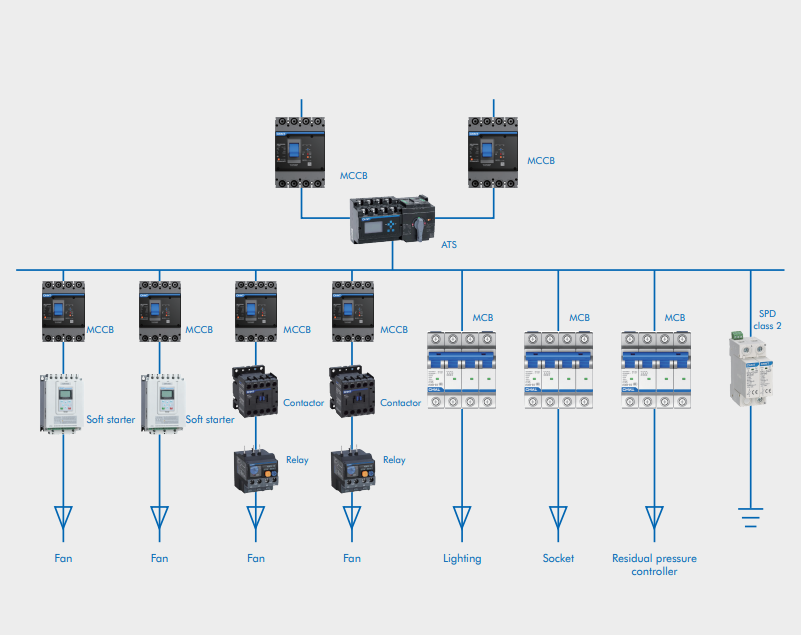
A typical panel may include an isolator, contactors, overload relays, a soft starter or VFD, control relays, timers, selector switches, terminal blocks, fault lamps, and BMS input and output terminals. It may also include metering or communication devices when the building team wants live status and energy data.
The panel has to do more than start a motor. It must protect the fan circuit, report run and fault status, accept BMS commands, and respond correctly during fire alarm events. Some fans must shut down to reduce smoke spread. Others may run in smoke purge mode to exhaust air from affected zones.
This makes commercial building ventilation electrical design both an energy issue and an operating issue. Electrical standards and fire safety requirements should both appear in the specification. Like with CHINT’s fan control solution, there’s high protection for high-energy building loads, including power distribution cabinets, soft starters, contactors, relays, ATS, MCCBs, MCBs, and SPDs to guarantee stable fan operation.
VFDs For Air Handling Units: The Energy Savings Case
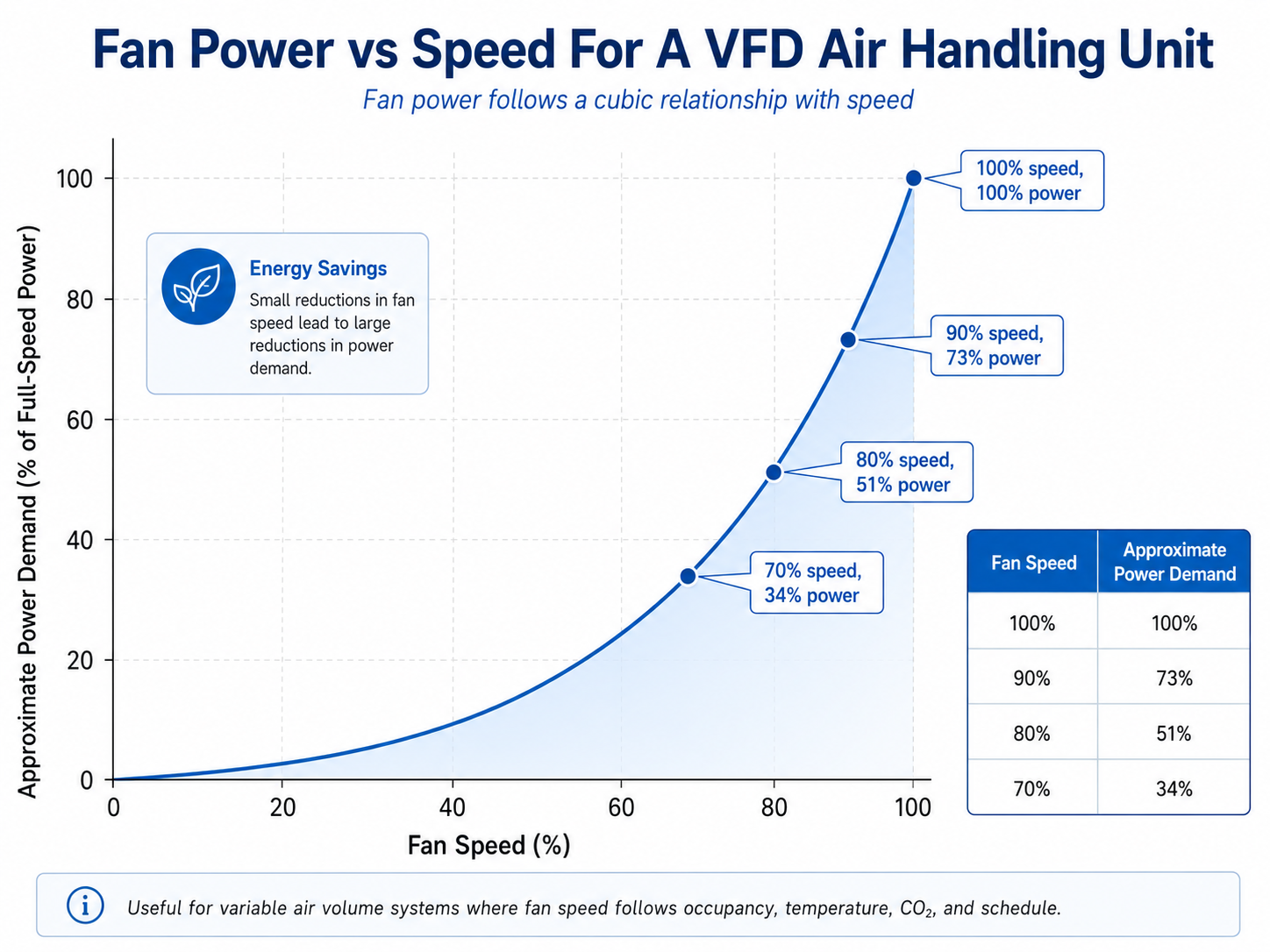
A VFD air handling unit controls fan motor speed to match airflow demand. This matters because fan power follows a cubic relationship with speed. At 80% speed, a fan uses roughly 51% of full-speed power, not 80%.
That relationship makes VFDs useful in variable air volume buildings. In a VAV system, zones call for more or less air as occupancy, outdoor temperature, CO₂ level, and schedule change. A VFD allows the AHU fan to follow that demand. Without variable speed control, a constant-speed fan may waste power through dampers or frequent cycling.
According to industry principles, motors consume nearly 40% of electricity in commercial buildings, and many motor applications are variable-torque fan, pump, and compressor loads that can benefit from variable speed control.
VFDs also introduce design checks. They can create harmonic currents, especially when many drives operate across one building distribution system. Harmonic review, reactors, filters, or drive selection may be needed to reduce transformer heating, nuisance trips, and BMS communication issues.
For a deeper background, CHINT’s energy efficiency in HVAC systems can support your review of fan and pump energy performance.
Motor Starter Selection For HVAC: Soft Starters Vs VFDs
Not every fan motor needs a VFD. A good HVAC motor starter large building design starts with the actual duty: motor size, start frequency, airflow demand pattern, supply capacity, and BMS control need.
A DOL starter can suit a small exhaust fan that starts infrequently and runs at one speed. It has a lower equipment cost and simple control logic, but it creates high starting current. You should check whether the upstream supply can tolerate that inrush without voltage dips.
A soft starter suits constant-speed fans where the main goal is to reduce inrush and mechanical stress during start. Constant-volume AHUs, smoke extract fans with limited starts, and exhaust fans that run at one design speed may fit this category.
A VFD fits variable-demand fans. Use it where airflow should follow pressure, CO₂, temperature, occupancy, or time schedule. Larger AHU motors that run for long hours usually deserve a VFD review because even modest speed reductions can reduce energy use.
To help you decide:
Application |
Demand Type |
Start Pattern |
Recommended Starter |
Small Exhaust Fan |
Constant speed |
Low |
DOL starter |
Constant-Volume AHU |
Fixed airflow |
Moderate |
Soft starter |
VAV AHU |
Variable airflow |
Continuous |
VFD |
Cooling Tower Fan |
Variable load |
Seasonal |
If you employ CHINT’s HVAC OEM solution, expect integrated control panels, monitoring technology, VFDs with DC chokes and EMC filters, remote monitoring, fault alarms, and real-time analytics for HVAC and refrigeration applications.
BMS Integration: What Is Possible And What Matters
BMS integration electrical control decides whether installed VFDs and panels respond to real building demand. A BMS should send speed, pressure, airflow, or temperature commands to the VFD. The panel should send run, stop, fault, local or remote mode, and alarm status back to the BMS.
Energy monitoring is also valuable. If the BMS receives kWh, current, demand, and operating hours from the VFD or a power meter, facility teams can compare fan energy with occupancy, weather, and comfort complaints. That turns the HVAC electrical panel into a measurable part of building performance.
Communication should be specified. Common interfaces include BACnet, Modbus, and LonWorks. The project documents should state the protocol, point list, alarm naming, control sequence, trend intervals, and commissioning tests.
The common gap is manual operation. Some buildings install VFDs, then leave them at fixed manual speed or connect them to a BMS without tuning the setpoints. Facilities can sacrifice 20% to 40% of potential savings when VFDs are left in manual mode or not connected to building automation.
Check CHINT’s buildings solutions overview, which covers power supply, main distribution, secondary distribution, and final distribution systems for residential, commercial, industrial, and public buildings. For HVAC electrical control systems, that wider building distribution context matters because fan panels, VFDs, metering, and protection devices must work with upstream switchboards.
Signs Your Fan And HVAC Control System Is Due For An Upgrade
BMS integration electrical control problems often appear as high energy bills, comfort complaints, or repeated maintenance tasks. These five signs can help facility managers decide when to investigate.
VFDs Run In Manual Mode. If a drive stays at a fixed speed, it cannot respond to occupancy, pressure, CO₂, or temperature demand. The building loses part of the savings that variable speed control was meant to capture.
Contactors Need Frequent Replacement. A contactor replaced every one or two years may be seeing more starts than its duty rating supports. Review the start frequency, AC-3 rating, motor current, and control sequence.
Breakers Trip Without A Clear Motor Fault. In buildings with many VFDs, nuisance trips can point to harmonic distortion, incorrect protection settings, heat, or poor coordination. A power quality assessment should follow repeated unexplained trips.
The BMS Shows No HVAC Energy Data. If your BMS cannot show fan kWh, demand, or run hours, energy review becomes guesswork. Metering should support your operating decisions, not sit outside the control conversation.
The Fan Panel Has No Fire Mode Interface. A building fan control panel should match the building’s fire strategy. Where shutdown or smoke purge is required, the panel should accept the signal, override normal BMS control, and prove the intended status.
These signs point to the same issue: commercial building ventilation electrical performance depends on the full chain, from motor starter to BMS sequence.
Conclusion
HVAC electrical control systems determine whether large-building fans run with demand or waste power. The right starter, a properly applied VFD air handling unit, clear fire-mode logic, and verified BMS connections can reduce energy use and make faults easier to trace.
To achieve energy efficiency in HVAC systems and application-specific support, explore CHINT’s fan control solution and HVAC OEM solution. Contact us to discuss fan control panel and HVAC electrical architecture requirements.
Frequently Asked Questions
What is the HVAC electrical system?
The HVAC electrical system encompasses all the electrical components that power, control, and protect the heating, ventilation, and air conditioning equipment in a building. It includes the distribution circuits that supply power to AHUs and fans, the motor starters or VFDs that control motor operation, the overload and fault protection devices, the fan control panels that integrate fire alarm and BMS signals, and the monitoring and metering equipment that measures energy consumption.
What are the four types of automatic controls in HVAC?
The four main types of automatic controls used in HVAC systems are: on/off control (the simplest, turning equipment fully on or fully off based on a setpoint), proportional control (modulates output proportionally to the deviation from setpoint), proportional-integral-derivative (PID) control (adds integral and derivative terms to eliminate steady-state error and reduce overshoot), and variable frequency drive control (adjusts motor speed rather than operating a damper or valve, delivering both precise control and energy savings).
What is the $5,000 rule for HVAC?
The "$5,000 rule" is an informal decision guideline sometimes used in the U.S. HVAC industry: multiply the system's age (in years) by its repair cost (in dollars); if the result exceeds $5,000, replacement may be more cost-effective than repair. For example, a 12-year-old unit requiring a $500 repair gives $6,000 (suggesting replacement consideration). Note that this is a rough heuristic, not an engineering standard, and should be applied alongside a professional assessment.
What circuit is most commonly used in HVAC equipment and control systems?
HVAC equipment predominantly uses three-phase AC circuits for main power supply to motors (fans, compressors, pumps) and single-phase AC for control circuits and smaller auxiliary equipment. Control wiring operates at 230V or 24V AC, with the lower voltage level increasingly used for BMS integration, safety circuits, and modern electronic controls. VFDs convert the three-phase supply to a variable frequency and voltage output to control motor speed.
What are the signs that an HVAC control system needs upgrading?
The main indicators are: VFDs operating in manual mode rather than responding to BMS demand signals; frequent motor starter or contactor failures suggesting duty cycle mismatch; unexplained circuit breaker trips that may indicate harmonic issues; the BMS cannot access real-time energy data from HVAC circuits; and fan control panels without fire mode integration in buildings where smoke control is required. Any of these issues represents a combination of energy waste and, in the last case, a potential life safety concern.