

In reality, voltage fluctuations emanating from power surges might be hazardous. Scientists have invented new mechanisms to curb power fluctuations in electrical systems with the advancement in technology. A miniature circuit breaker is one such mechanism.
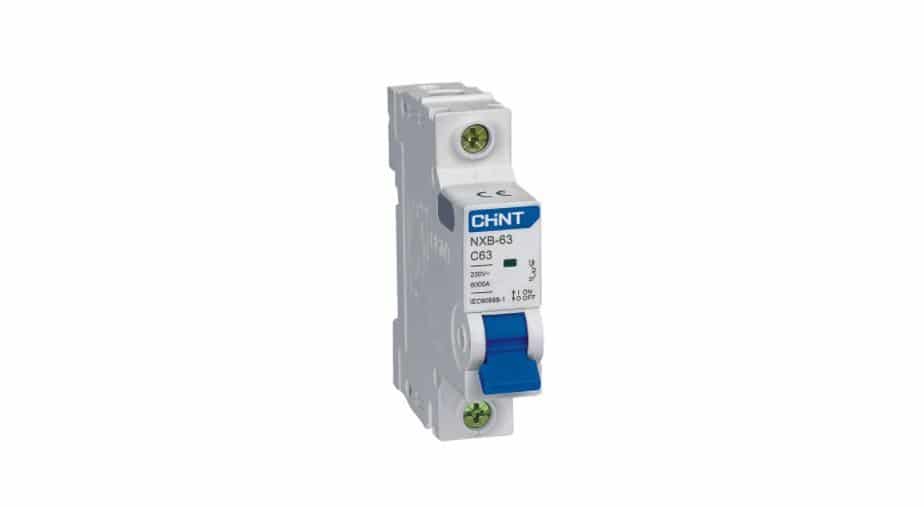
An MCB is an automatically operated electrical switch. Miniature circuit breakers are intended to prevent damage to an electrical circuit as a result of excess current. They are designed to trip during an overload or short circuit to protect against electrical faults and equipment failure.
What is a Miniature Circuit Breaker?
A small electromagnetic circuit breaker protects electrical circuits from short circuits and overcurrent. This device operates automatically, meaning if a short circuit or overcurrent occurs, the MCB will automatically protect the electrical circuit.
The MCB can quickly detect and react to faults. In particular, the MCB will help switch the circuit to an open state when the current that passes through exceeds the set value. Therefore, the main purpose of the MCB is to interrupt the flow of current and determine the fault conditions.
What is a miniature circuit breaker used for?
Home Electrical Panels
You can use MCBs to safeguard your home from electrical overload. These devices are safer and reliable to use than fuses because they can handle significant amounts of electricity. Also, the MCB ensures equal distribution of electrical energy in all devices. When you use this device, you will experience limited power fluctuations in your home.
Lights
Most households have an extensive lighting system. MCBs can play a critical role in the effective distribution of electricity across all your lighting systems in the house.
For instance, operating fluorescent lamps requires more electricity than normal light bulbs. That is where MCB become helpful. Further, MCB assists in maintaining the safety and quality of light bulbs.
Industrial applications
You can use MCBs as an effective safety mechanism in large-scale and small-scale industries. In reality, most of the industry equipment needs a power supply of approximately 30kA.
In such a case, you need to avoid using old fuses and switch to MCBs. MCBs help maintain installations and applications’ efficiency by optimizing their energy flow when it comes to commercial settings. The common industrial applications of MCB include bakeries, supermarkets, and hotels.
Heaters
If you have installed heaters in your office or home, the MCBs are dependable safety solutions you can use. In most cases, heaters easily develop high voltage fluctuations since they draw significant power from the main supply. However, with an effective installation of an MCB, you can avoid such scenarios.
Ground Fault Trip Mechanism
You can easily use an MCB and an arc fault or ground fault mechanism. A ground fault happens when a live wire contacts a transmitter surface that does not form part of the circuit system. In that case, the current flow rate rises with a fault in a circuit. Then, the MCB will rectify the circuit system and initiate its magnetic tripping.
What are the three types of miniature circuit breakers?
Plug-in
These circuit breakers make their connection to the load center through plugging in. In particular, a recessed clip that is visible at the end of the circuit breaker plugs into the electrical bus of the load center during installation.
These devices have become common due to their quick and easier installation. Plug-in MCBs are available for 60Hz and 50Hz and voltages between 600V.
Bolt-on
You can easily identify the bolt-on circuit breakers by a metal flange that protrudes from the housing of the circuit breaker. A screw installed through this flange attached the circuit breaker to the load center’s electrical bus of the load center. Currently, bolt-on circuit breakers are not common in residential applications.
Cable in/Cable-out
Every pole of these circuit breakers offers arch chutes with 5-100A continuous in one, two, and three-pole designs and a steel frame calibration. They also have varied ring tung termination and mounting options.
What is the advantage of a miniature circuit breaker?
Sealable handle
Sealing provides an effective and safe method for locking out MCBs in OFF and ON positions. That enables the user to perform safe maintenance securely, prevent tampering, control the power supply, and securely lock the circuit breaker.
High ingress protection
MCB is touch-safe. It has a rating of IP20, meaning it can offer protection from solid objects of approximately 12mm, including adult fingers.
Environmentally friendly
Due to the latest generation of halogen-free thermoplastics, it is possible to recycle MCBs, enabling you to minimize environmental pollution.
Minimal power loss
You can calculate power loss based on the voltage drop in the main terminals normally measured at the rated current of a device. Fortunately, MCB has a low power loss at its terminals.
Trip free mechanism
The MCB will trip when a short circuit or overload happens, even if you maintain the operating lever in the ON position. Such a feature provides a protection function, especially when the handle is defective or broken. Further, such safety features make manually holding the contacts closed during fault or overcurrent conditions impractical.
Long lifespan and safe operation
MCBs guarantee several years of consistent efficiency. Every pole of these circuit breakers is secure individually. When a fault occurs, it will switch all the poles off, and the trigger features will remain reliable throughout its lifetime.
Also, when a fault happens, the arc mechanism will extinguish the arc quickly, which helps to reduce fire risk and maximizes the lifespan of the equipment.
Compact and universal
MCBs have both disconnector and circuit protection functions. In this case, the isolation and overcurrent protection operations are undertaken in one unit. Apart from that, the dimensions of MCBs are compact, meaning you can save a lot of space if you mount them side by side.
What is the difference between MCB and circuit breakers?
- Circuit breakers have a tripping relay mechanism, while MCB has a tripping release mechanism.
- Circuit breakers have a high rupturing capacity, but the MCB has a low rupturing capacity.
- Circuit breakers are used in High Voltage systems, while MCBs are used in Low Voltage systems.
Conclusion
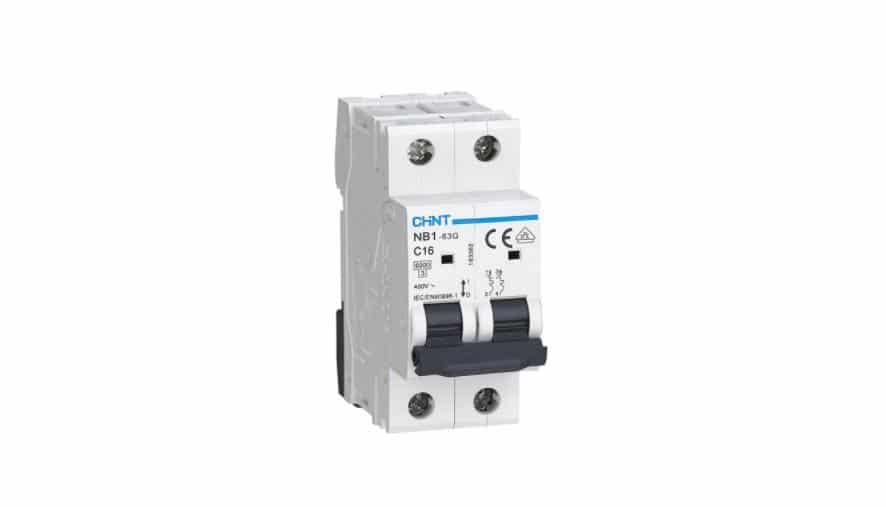
Effective installation of MCBs can help protect and secure electrical systems in all industries and households. CHINT is one of the most famous and trusted brands for MCB products that you can easily access online.
The products from this company resonate with high-quality performance and standards. Further, the company is dedicated to ensuring the community’s well-being and its customers by offering safe and reliable MCB products.