

Introduction
Energy efficiency in steel manufacturing starts with the plant electrical system. Steel and metals facilities depend on motors, drives, furnaces, transformers, switchgear, and control systems that run across long production cycles. Energy can represent about 20% of steel manufacturing cost, and the global steel industry consumes about 8% of global energy each year.
For plant electrical engineers, operations directors, and energy managers, the opportunity sits inside the metallurgical electrical system: motors, drives, metering, power factor correction, and steel plant power distribution.
The Biggest Sources Of Electrical Energy Waste In Steel Plants
Before a plant selects upgrades, teams need to know where waste appears. In steel and metals plants, electrical waste comes from motor systems, poor power factor, harmonics, fixed-speed drives, and aging distribution equipment.
Large induction motors drive conveyors, fans, pumps, compressors, rolling mill auxiliaries, hydraulic units, and material handling equipment. When these motors run at fixed speed during partial-load operation, they can draw more energy than the process needs. This matters in ventilation, cooling water, dust collection, and pumping systems where demand changes throughout the shift.
Poor power factor creates another drain. Large motor loads draw reactive power, which increases apparent current in feeders, transformers, and switchgear. That extra current raises losses and can lead to utility penalties where tariff structures include power factor charges.
And there’s harmonics. Arc furnaces, rectifiers, and VFDs can introduce distortion that heats transformers and motors, affects meters, and weakens power quality.
Older LV distribution metals manufacturing infrastructure can add losses through higher resistance, weak monitoring, and limited fault visibility. In a high-load metallurgical electrical system, those losses repeat every operating hour.
Here’s a quick summary of energy waste sources in a steel plant:
Energy Waste Source |
How It Shows Up |
Primary Mitigation |
Fixed-speed motors |
High kWh during low demand |
VFDs or revised controls |
Poor power factor |
High apparent current |
Capacitor banks or SVG |
Harmonics |
Heat, trips, meter errors |
Filters and monitoring |
Aging distribution |
Losses and poor visibility |
Digital distribution upgrades |
Intelligent Motor Control Centers: Efficiency At Scale
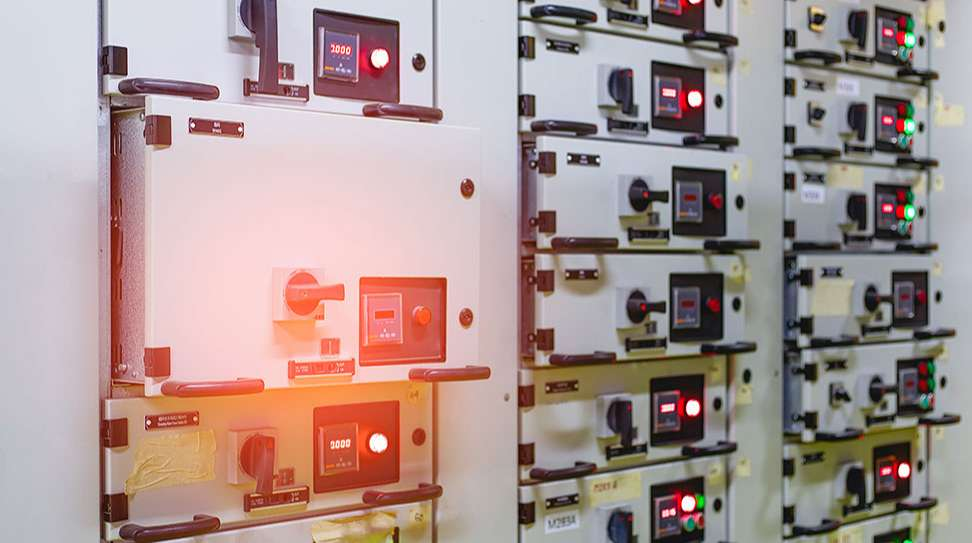
Motor control centers sit close to many of the loads that shape plant energy use. An intelligent motor control centre steel project adds monitoring, control, and maintenance data to the motor circuits that already run the plant.
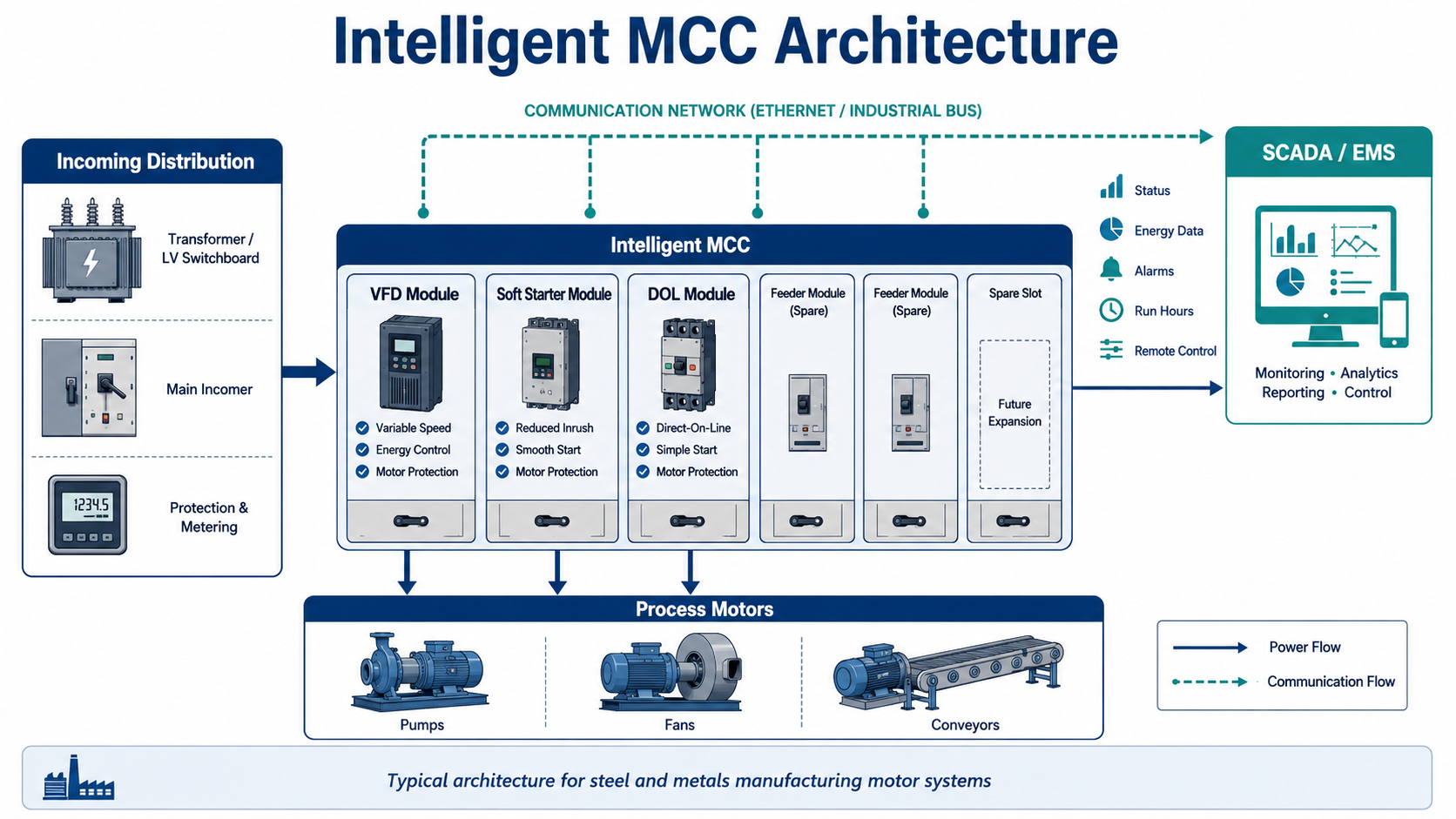
A modern MCC can include VFDs for variable-demand motors, soft starters for heavy motors with less frequent starts, electronic overload relays, power monitoring modules, and communication links to SCADA or an energy management platform. CHINT’s intelligent motor control center solution provides smart motor control devices for real-time equipment monitoring, motor operation programs, and maintenance management strategies.
The first energy target is usually variable-load equipment. Fans, pumps, cooling circuits, and hydraulic power units often run below peak demand for much of the day. A VFD lets the motor follow the process needed instead of running at full speed. Soft starters still have value where the main need is controlled starting rather than speed variation.
Motor health data also helps. Electronic overload relays can monitor thermistor input, imbalance, run hours, and fault events. The U.S. DOE estimated that about 12% of electricity used by motors and fans in the steel industry could be saved by replacing existing facilities with more efficient equipment and systems. So for teams working on energy efficiency in steel manufacturing, per-motor visibility is the difference between a general energy target and a ranked list of practical projects.
HV/MV/LV Digital Distribution: What It Means And Why It Matters
Steel plants operate across several voltage levels.
HV supply brings power into the site.
MV systems feed large drives, furnaces, transformers, and process areas.
LV systems serve auxiliary motors, lighting, control panels, cooling circuits, compressors, and plant services.
When these layers operate separately, energy teams lose the full picture.
Digital steel plant power distribution links these layers through protection relays, meters, power quality monitors, event logs, and communication. Instead of waiting for a monthly utility bill, engineers can see demand, power factor, harmonic distortion, imbalance, and load changes by production area.
Submetering is the foundation. If melt shop auxiliaries, rolling mill drives, compressed air, water treatment, and finishing lines are metered separately, the plant can compare energy use against output. That helps teams find areas consuming more than expected.
Digital distribution also improves post-fault analysis. Event logs help engineers see what happened before a trip. Arc flash detection, where specified, can isolate the affected zone quickly and limit damage.
CHINT’s HV/MV/LV digital distribution solution provides real-time monitoring, proactive prediction, precise control, and intelligent management for metallurgical distribution systems. The solution also covers power quality monitoring, energy management, lifecycle management, and selective protection features.
For LV distribution metals manufacturing, this creates a better basis for maintenance, load planning, and energy cost control.
Real-World Results: Electrical Upgrades And The Energy Economics Of A Steel Plant
The scale of the steel sector makes electrical savings meaningful. The integrated BF-BOF route requires about 19 to 24 GJ per tonne of crude steel, while scrap-based EAF production uses much less energy. According to Steel Industry Facts & Figures, EAF can use up to 74% less energy than the integrated route. The International Energy Agency (IEA) also notes that scrap-based electric arc furnace production is 60% to 70% less energy-intensive than primary production.
Plant route changes are major strategic choices, but electrical upgrades can still reduce waste in existing operations. Intelligent MCCs identify motor circuits with unusual consumption. Digital distribution shows demand peaks, reactive power, and harmonic issues. Reactive power compensation reduces apparent current and can improve voltage quality. Better metering supports cost allocation by production unit.
This is where an energy saving smelting plant program should stay practical. Instead of starting with a plant-wide ambition, teams can begin with high-load motors, VFD candidates, reactive power trends, and weakly monitored distribution boards.
In CHINT’s Steel Industry Partnership Case Study, supplying low-loss power equipment, including transformers, for a steel plant project focused on energy saving and decarbonization. With integrated products, one-stop service capability, and site construction support, steel businesses improve when energy savings, reduced downtime, better maintenance planning, and lower carbon intensity are reviewed together.
Where To Start: An Electrical Efficiency Audit For Steel Plants
An audit for energy efficiency in steel manufacturing should start with data. Here’s a five-step process that helps plant teams decide where to invest first.
Complete a metering audit. Map consumption by production area, major feeder, transformer, and high-load process. If the plant cannot see energy by area, it cannot rank savings work with confidence.
Run a motor survey. List motors above 22 kW, then flag those serving variable-demand loads. Fans, pumps, cooling water circuits, hydraulic systems, and conveyors are strong early candidates. Record existing starter type, duty cycle, load profile, and maintenance history.
Complete a power quality assessment. Measure power factor, harmonic distortion, voltage profiles, imbalance, and demand peaks at key nodes in the steel plant power distribution network.
Review protection and maintenance data. Nuisance trips, hot motors, overloaded feeders, and repeated alarms may point to hidden energy issues. A motor running hot may be wasting energy before it fails.
Rank investments by payback and risk reduction. VFDs on fans and pumps often come first. Reactive power compensation may follow where the power factor is poor. Digital distribution and metering upgrades then support long-term management across LV distribution metals manufacturing systems.
The aim is not to replace everything at once, but to build a measured, repeatable improvement path.
Conclusion
Energy efficiency in steel manufacturing is a present-day operating and financial opportunity. Motors, drives, metering, reactive power compensation, and digital distribution give plants a practical way to cut waste without waiting for a full process rebuild. For an energy saving smelting plant plan, the best starting point is the electrical data already flowing through the plant.
CHINT’s metallurgical solutions support digital distribution, real-time monitoring, lifecycle management, high- and low-voltage equipment, transformers, instruments, motor start control, VFDs, soft starters, and protection solutions for metallurgical facilities. Contact us for application-specific guidance.
Frequently Asked Questions
How much electricity does it take to produce one tonne of steel?
This varies by process route. The integrated blast furnace-basic oxygen furnace (BF-BOF) route uses approximately 19–24 GJ per tonne overall, though electricity is only a portion of this (the route is largely coal-intensive). The scrap-based electric arc furnace (EAF) route uses approximately 400–700 kWh of electricity per tonne of steel, depending on scrap quality and process efficiency. EAF production is 60–70% less energy-intensive overall than the BF-BOF route.
What are the main sources of energy waste in a steel mill?
The main electrical energy waste sources are: large motors running at fixed speed on variable-demand applications (fans, pumps, compressors), poor power factor from high induction motor loads, harmonic distortion from arc furnaces and rectifiers causing transformer and motor overheating, and aging distribution infrastructure with higher resistance losses. Addressing motors first, particularly with VFDs on variable-demand loads, delivers the fastest return.
What is an intelligent motor control centre?
An intelligent motor control centre (MCC) is a distributed motor control system that goes beyond simple switching and protection. It includes VFDs, electronic overload relays with motor monitoring, soft starters, power metering per circuit, and communication interfaces that connect to plant SCADA or energy management systems. Intelligent MCCs provide real-time data on energy consumption, motor health, and operating hours for condition-based maintenance and energy optimisation.
What is IE2, IE3, and IE4 motor efficiency?
These are international efficiency class ratings for induction motors, defined by IEC 60034-30. IE2 (High Efficiency) is the minimum permissible class in many markets for motors above certain ratings. IE3 (Premium Efficiency) reduces losses by approximately 20% compared to IE2. IE4 (Super Premium Efficiency) represents the highest commercially available efficiency class. In steel plants with hundreds of motors, upgrading from IE1 or IE2 to IE3 on large motors can deliver measurable energy savings. The combination of IE3+ motors with VFDs for variable-demand applications produces the greatest efficiency gains.
Where should a steel plant start its electrical efficiency programme?
The most accessible starting point is a motor survey: identify all motors above 22 kW that drive variable-demand loads (fans, pumps, cooling water systems) and are currently running at fixed speed. These are candidates for VFD retrofits with rapid payback. In parallel, a power quality assessment can identify whether poor power factor or harmonic distortion is adding hidden costs and damage to the distribution system. A structured metering audit that establishes energy consumption by production area is an essential foundation for tracking improvement over time.