

Introduction
Microgrid system design has moved from future planning into active infrastructure work across communities, industrial campuses, utilities, and remote sites. A microgrid can support energy resilience, renewable integration, and remote site power supply, but only when project teams understand the fundamentals before choosing equipment.
Market demand supports that shift. The U.S. microgrid market was estimated at USD 14.82 billion in 2024 and is projected to grow at an 18.2% CAGR from 2025 to 2030. So let this microgrid components guide explains topology, generation, storage, microgrid switchgear, control, and protection decisions that shape project performance from feasibility to power-on.
What Is A Microgrid And When Does One Make Sense?
A microgrid is a localized energy system with its own generation, storage, distribution, and control. It can operate connected to the main grid or independently in island mode. In practice, that means a defined group of loads can keep receiving power from local resources when the wider grid is unavailable, unstable, or too costly to extend.
A microgrid makes sense when your site has one or more clear drivers. The grid connection may be unavailable for a mining site, island community, rural facility, port, or telecom site. The grid may exist but fail too often for a hospital, data center, military facility, or process plant. A site may also have strong renewable resources, high energy costs, or a strategic need for energy independence.
A microgrid may not be the best answer for every project. If the grid is reliable and the site has no resilience target, reinforcing the existing grid connection may cost less than building local generation and storage. Early microgrid system design should compare grid reinforcement, standby generation, solar-plus-storage, and full microgrid options before budgets are locked.
For remote communities and infrastructure, remote site power supply becomes the deciding issue. In those cases, islanding microgrid protection cannot be treated as a late electrical detail. It defines how the system separates from the grid, protects people and assets, and reconnects safely when grid supply returns.
The Four Core Layers Of A Microgrid System
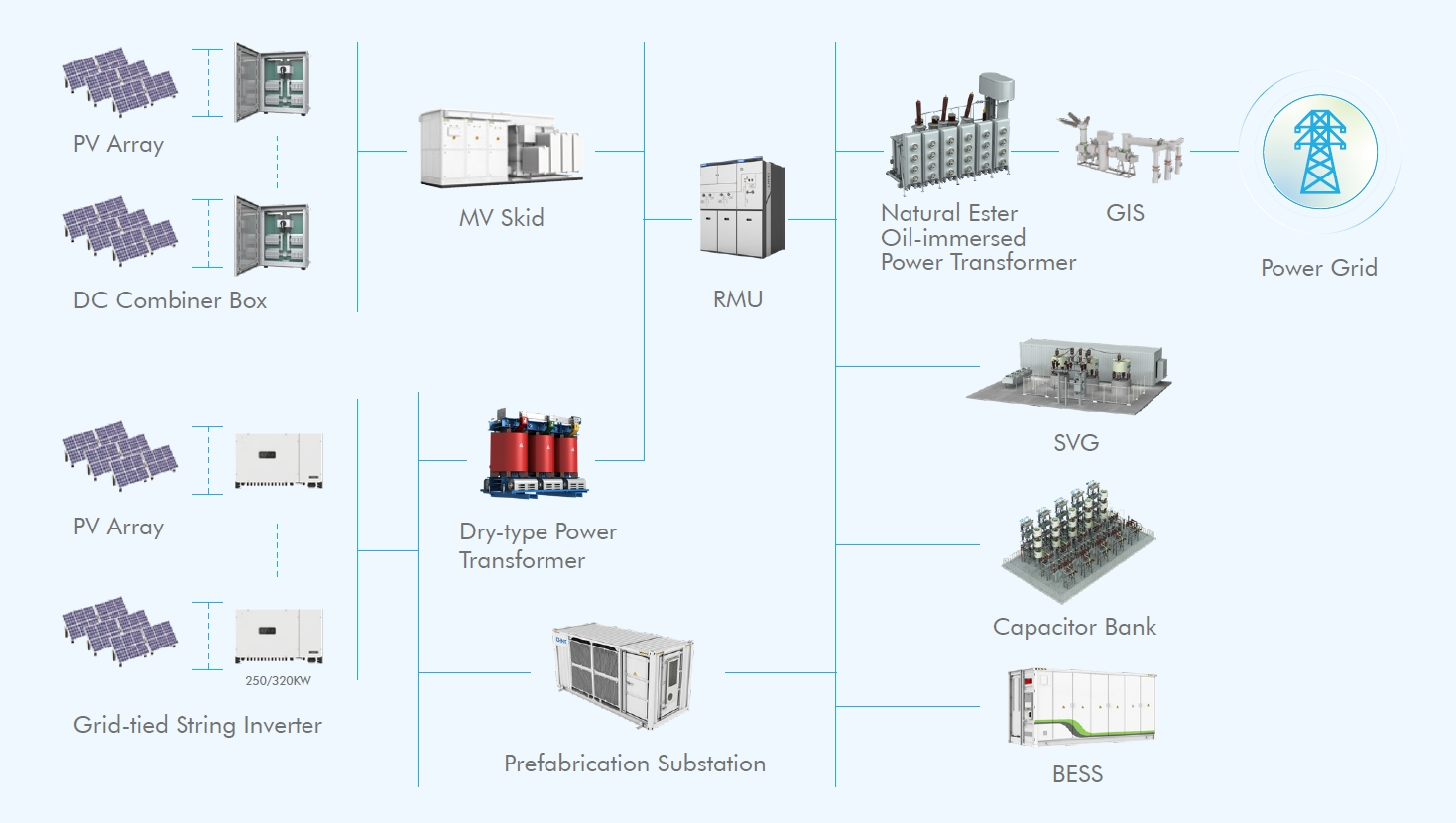
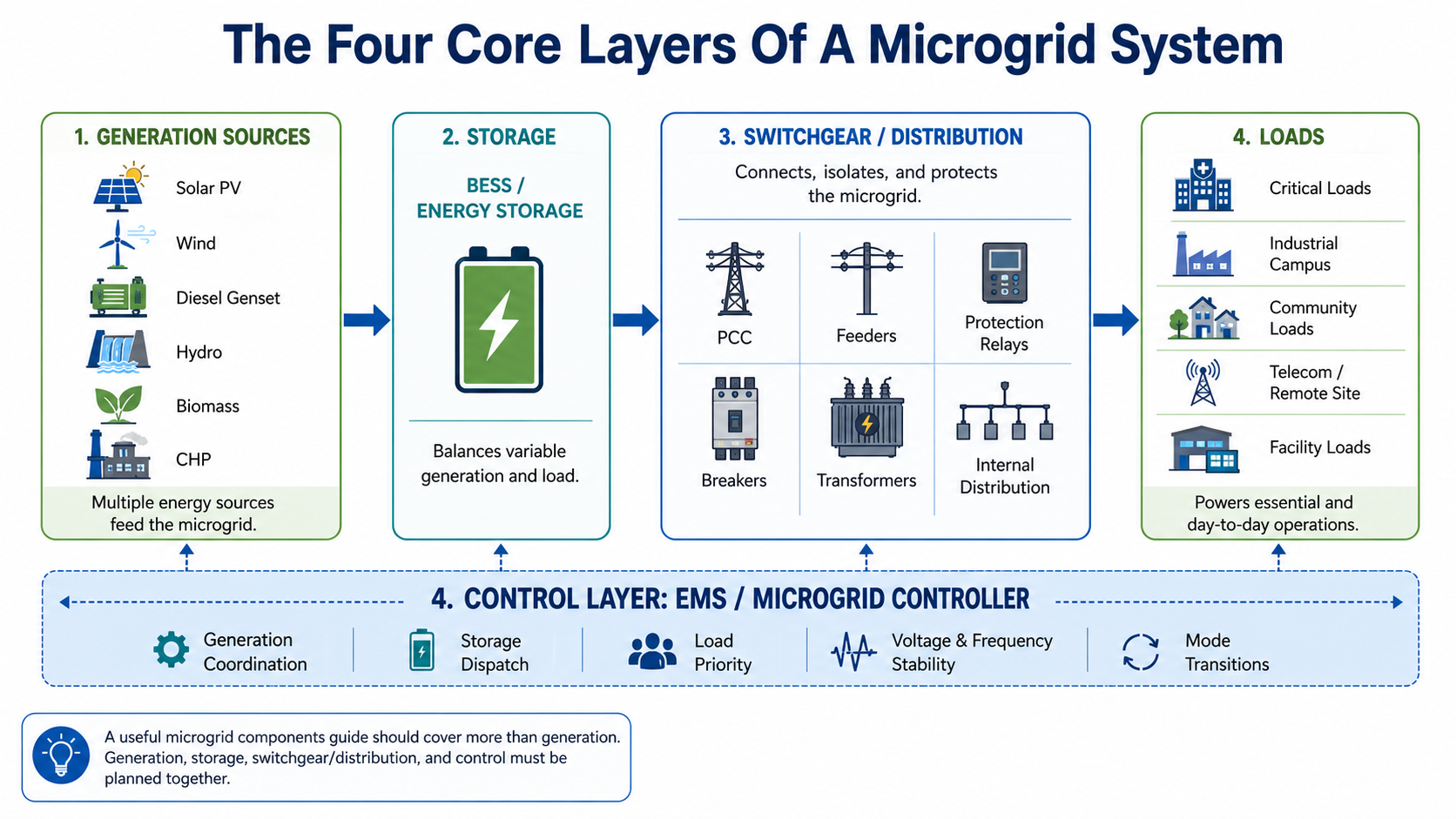
A useful microgrid components guide should cover more than generation. Four layers work together: generation, storage, switchgear and distribution, and control.
The generation layer can include solar PV, wind, diesel gensets, hydro, biomass, or combined heat and power. These sources behave differently. Solar and wind vary with weather. Gensets and CHP can dispatch power when called. The control system must coordinate these differences while serving the load.
The storage layer, usually Battery Energy Storage System (BESS), helps balance variable generation and changing demand. Storage sizing depends on critical load, outage duration, renewable output, tariff strategy, and seasonal resource patterns. A good BESS solution supports renewable energy use, grid stability, and energy cost management across utility-scale and C&I applications.
The switchgear and distribution layer includes the point of common coupling, feeders, protection relays, breakers, transformers, and internal distribution. This is where microgrid switchgear connects, isolates, and protects the system.
The control layer, often an EMS or microgrid controller, supervises generation, storage, load priority, voltage, frequency, and mode transitions. In fact, the microgrid control systems market was estimated at USD 4.27 billion in 2024 and forecast to reach USD 7.79 billion by 2029. This reflects the growing role of control in project planning. CHINT’s utility PV solution can support generation planning where utility-scale PV forms part of the microgrid.
Grid-Connected Vs Off-Grid: Choosing The Right Topology
Topology affects cost, protection, controls, and commissioning. A grid-connected microgrid normally operates in parallel with the utility. It can import energy, export where allowed, and disconnect during grid disturbances. This is common for campuses, commercial sites, industrial parks, and utility-linked resilience projects. Future Market Insights reports that grid-tied architectures hold the largest share at 72.0%, and it forecasts the overall microgrid market to grow at a 10.1% CAGR from 2026 to 2036.
An off-grid microgrid has no normal utility connection. It must cover the site’s full load at all times, including peak demand, night operation, low-renewable periods, and maintenance events. Strong off-grid power system design usually requires more generation reserve, more storage, tighter load controls, and a clear fuel or renewable resource strategy. This topology fits remote mines, islands, isolated villages, border facilities, and other sites where grid extension costs are high.
A hybrid microgrid may combine grid supply, solar, gensets, storage, and controllable loads. Roots Analysis tracks microgrid markets across on-grid, off-grid, and hybrid connectivity, and projects the global microgrid market to reach USD 173.3 billion by 2035. Hybrid systems can switch operating modes, but they also raise protection and control demands.
Your choice should start with four questions: how reliable is the existing grid, what outage duration must the site survive, what export or islanding rules apply, and how much autonomy is worth paying for? The topology decision sets the basis for islanding microgrid protection and reconnection controls.
Islanding Protection And Fault Management: The Technical Challenges
Islanding is the defining challenge in microgrid system design. It occurs when the microgrid continues energizing local circuits while the main grid is offline. Intentional islanding supports resilience. Unintentional islanding creates risks for utility personnel and can damage equipment if reconnection happens out of phase.
Islanding microgrid protection starts at the point of common coupling, where the microgrid connects to the utility. Protection relays and controller logic must detect abnormal conditions and open the coupling device when needed. Detection methods can be passive, active, or communications based.
Passive methods monitor voltage, frequency, and phase behavior.
Active methods inject a small disturbance and read the system response.
Communications-based schemes use direct signals between the utility and microgrid controller.
IEEE 1547-2018 includes requirements for distributed energy resources related to unintentional islanding. National Renewable Energy Laboratory (NREL) describes the standard as a key interconnection document for DERs, including solar and energy storage systems. NREL guidance also notes that a DER interconnection system must detect an unintentional island and cease energizing within two seconds in the IEEE 1547 requirement context.
Fault management inside the microgrid also changes by mode. In grid-connected mode, utility fault current may be high. In islanded mode, smaller generators and inverters may provide lower fault current. Standard overcurrent settings may fail to detect a fault that would be clear on the main grid.
Your microgrid switchgear, relays, and breakers should be reviewed for both operating modes. That’s why CHINT microgrid solutions supports microgrid work from consulting and engineering design through construction and long-term project maintenance.
What Project Teams Get Wrong In Microgrid Planning
Planning mistakes usually appear later as cost increases, delayed commissioning, or control problems. These five issues deserve early review.
1. Undersizing The Storage System
Many projects size BESS around average daily demand. That misses extended low-generation periods, seasonal solar changes, cloudy weeks, or outage duration targets. Size storage around critical load duration, not only normal daily shifting.
2. Not Planning For Mode Transitions
Moving from grid-connected to islanded mode is a control event. Voltage, frequency, and load balance can shift quickly. Specify transition logic, test procedures, load priority, and restart sequence before equipment orders.
3. Using Grid-Based Protection Settings In Island Mode
Fault current changes when the utility source disappears. Protection settings should be checked in grid-connected and islanded modes, with attention to inverter limits, genset contribution, and relay sensitivity.
4. Omitting Grid Synchronization Control
Reconnection requires voltage, frequency, and phase matching. Closing out of phase can stress transformers, breakers, and rotating equipment. Synchronization logic should be part of the scope, not an afterthought.
5. Under-Specifying The Control System
Hardware cannot compensate for unclear operating logic. Commercial and industrial buildings held the largest microgrid market share in 2024, driven by the need for reliable and cost-aware power for critical operations. Those sites need controls that operators can monitor, test, and maintain.
Conclusion
Microgrids work well when they are planned well. The equipment is mature, but project value depends on early decisions around topology, storage sizing, microgrid switchgear, controls, and islanding microgrid protection. Teams that invest in microgrid system design before procurement can reduce redesign, improve commissioning readiness, and build systems that support real operating needs.
For project-specific technical support, CHINT microgrid solutions and distribution grid solutions support distribution grid projects from consulting and engineering design through construction and long-term maintenance.
Frequently Asked Questions
How does a microgrid system work?
A microgrid system generates, stores, and distributes electricity within a defined local area. It includes generation sources (solar, wind, generators), storage (typically battery systems), distribution switchgear, and a control system that manages power flow between them. It can operate connected to the main grid, importing or exporting power as needed, or it can island — disconnecting from the main grid and operating independently when the grid fails or is unavailable.
How do you design a microgrid?
Designing a microgrid starts with a load analysis: understanding peak and average demand, critical vs non-critical loads, and any future demand growth. This feeds a generation and storage sizing exercise that defines what combination of solar, wind, and battery is needed. The electrical design then covers the distribution architecture, protection relay settings (for both grid-connected and islanded operation), switchgear specification at the point of common coupling, and the control system logic. Grid interconnection requirements and local standards must be confirmed before design is finalised.
What are the disadvantages of microgrids?
The main disadvantages are higher upfront capital cost compared with a simple grid connection, greater complexity in protection design (particularly for islanding), and the ongoing need for a technically capable operations team or a service agreement with a specialist provider. For sites with a reliable grid connection and no critical resilience requirement, a microgrid may not offer sufficient economic return to justify the investment.
Are microgrids AC or DC?
Most microgrids are AC systems, as they align with standard grid infrastructure and are compatible with most loads and generation equipment. DC microgrids are a growing segment, particularly where the majority of loads and generation sources are inherently DC (such as data centres and solar-heavy systems), as they can avoid multiple AC-DC conversion losses. Hybrid AC/DC microgrids combine both distribution types and are increasingly common in complex applications.
How expensive is a microgrid?
Microgrid costs vary enormously depending on size, location, generation mix, storage capacity, and complexity of the control and protection system. A simple remote off-grid system for a small community might cost USD 1–3 million. A large industrial campus microgrid with substantial storage and grid interconnection could cost tens of millions. As battery costs have fallen substantially over the past decade, the economics of microgrid projects continue to improve. A detailed feasibility study is always required before budgeting.