

Introduction
Power quality monitoring matters in oil and gas because long distribution lines, remote generation, large motor loads, and sensitive instrumentation operate in one electrical network. When voltage sags, harmonics, transients, or imbalance go untracked, they can appear as process trips, damaged electronics, false alarms, or intermittent DCS faults.
For operations engineers and reliability teams, oil gas electrical system reliability depends on seeing these events early, especially across oilfield power distribution networks where site access, distance, weather, and production pressure make troubleshooting harder. Oil and gas operations face higher power quality risk because harsh environments and long distribution lines increase exposure to voltage instability and phase imbalance.

What Power Quality Problems Look Like In Oil And Gas
The first sign of poor power quality is rarely a report labeled “power quality.” Your team may see nuisance breaker trips, transformer overheating, drive faults, instrument drift, communication drops, or pump motors running hotter than expected. Strong power quality monitoring connects those symptoms to the electrical events behind them.
Typical commercial and industrial power quality problems include voltage sags and swells, harmonics, transients, voltage imbalance, and interruptions, with transients linked to data corruption, equipment malfunction, equipment damage, and process interruption.
In remote oilfields, sags and swells can come from generator loading changes, motor starts, and switching on radial feeders. Harmonics come from non-linear loads such as VFDs, rectifiers, UPS systems, welding equipment, and other power electronics. Harmonic distortion can heat transformers and motors, affect sensitive equipment, and create false trip conditions.
Transients and surges are another concern in exposed infrastructure. Long overhead lines can pick up lightning-induced energy, while switching operations can create transient overvoltages. Voltage imbalance can occur when three-phase systems feed uneven single-phase loads, raising negative sequence currents that increase motor heating, vibration, and bearing stress.
How Harmonics And Voltage Fluctuations Affect DCS And Instrumentation
The DCS and field instrumentation are the most sensitive parts of an oil and gas electrical system. A short voltage sag may not trip the upstream breaker, yet it can reset a DCS controller, disturb an I/O rack, or drop communication to a field device.
That is why DCS power quality deserves a dedicated review. DCS power supplies, instrument transformers, electronic trip units, communication gateways, and analog signal loops all react differently to waveform distortion, voltage dips, and grounding problems.
Harmonics deserve close attention because they come from equipment that oil and gas sites use every day. Regarding electrical power quality, harmonics are associated with non-linear loads and wider use of power electronics. In pumping systems, VFDs also bring a clear operating benefit. A 20% speed reduction can reduce energy use by up to 50% in relevant centrifugal applications. The same VFD population should be reviewed for harmonic distortion and filter needs.
Power Quality Problem |
Primary Affected System |
Typical Symptom |
Voltage Sag |
DCS power supply, drives |
Module reset, drive trip |
Harmonics |
Transformers, relays, instruments |
Heat, nuisance trip, bad readings |
Transients |
DCS panels, communications |
Damaged electronics |
Voltage Imbalance |
Motors, pumps, compressors |
Heating, vibration, bearing wear |
For refinery electrical control, knowing the problem, the affected system, and the symptoms helps operations and electrical teams discuss the same event from both sides: process impact and electrical cause. And with CHINT’s refining production power distribution and DCS control system solution, it's easy to connect high, medium, and low voltage distribution with DCS control for process stability, using intelligent switchgear and power cabinets as part of the system.
The Role Of SPDs And Surge Arresters In Remote Extraction Sites
Remote extraction sites face a different surge profile from a compact industrial plant. They use long overhead MV and LV lines, radial feeders, local transformers, outdoor cabinets, and exposed wellhead equipment. These conditions make surge protection oil gas planning a practical reliability requirement, not only a device selection task.
A layered approach usually works best.
Type 1 SPDs protect at the service entrance or transformer secondary where lightning energy may enter the LV system.
Type 2 SPDs protect main distribution boards and feeder panels.
Type 3 SPDs sit close to sensitive terminals such as DCS panels, instrument power supplies, PLC cabinets, communication devices, and analyzer shelters.
MV surge arresters also matter on the line side of transformers. Selection should review continuous operating voltage, protection level, grounding, insulation coordination, and the downstream SPD arrangement. A well-coordinated scheme helps energy discharge in stages instead of letting one device carry the full event.
Common installation errors reduce SPD performance.
Long leads add impedance.
Weak bonding limits the discharge path.
Type 3 protection cannot replace upstream Type 1 or Type 2 protection.
Missing status inspection leaves degraded devices in service after a surge event.
Once you know the top 4 power quality issues, it’s easy to identify transient overvoltages as events triggered by lightning, switching, or fault clearing, with SPDs used to divert excess voltage from key components. CHINT’s oilfield extraction power distribution solution supports intelligent, reliable oilfield power distribution with smart connected distribution products, state monitoring, remote control, VFDs, and contactors for extraction processes.
DCS Integration: Why Electrical And Control Systems Must Work Together
In modern oil and gas facilities, the electrical system and control system should share context. A voltage sag, harmonic alarm, earth fault, or breaker event can be a process event if it affects pumps, compressors, analyzers, skids, or DCS cabinets.
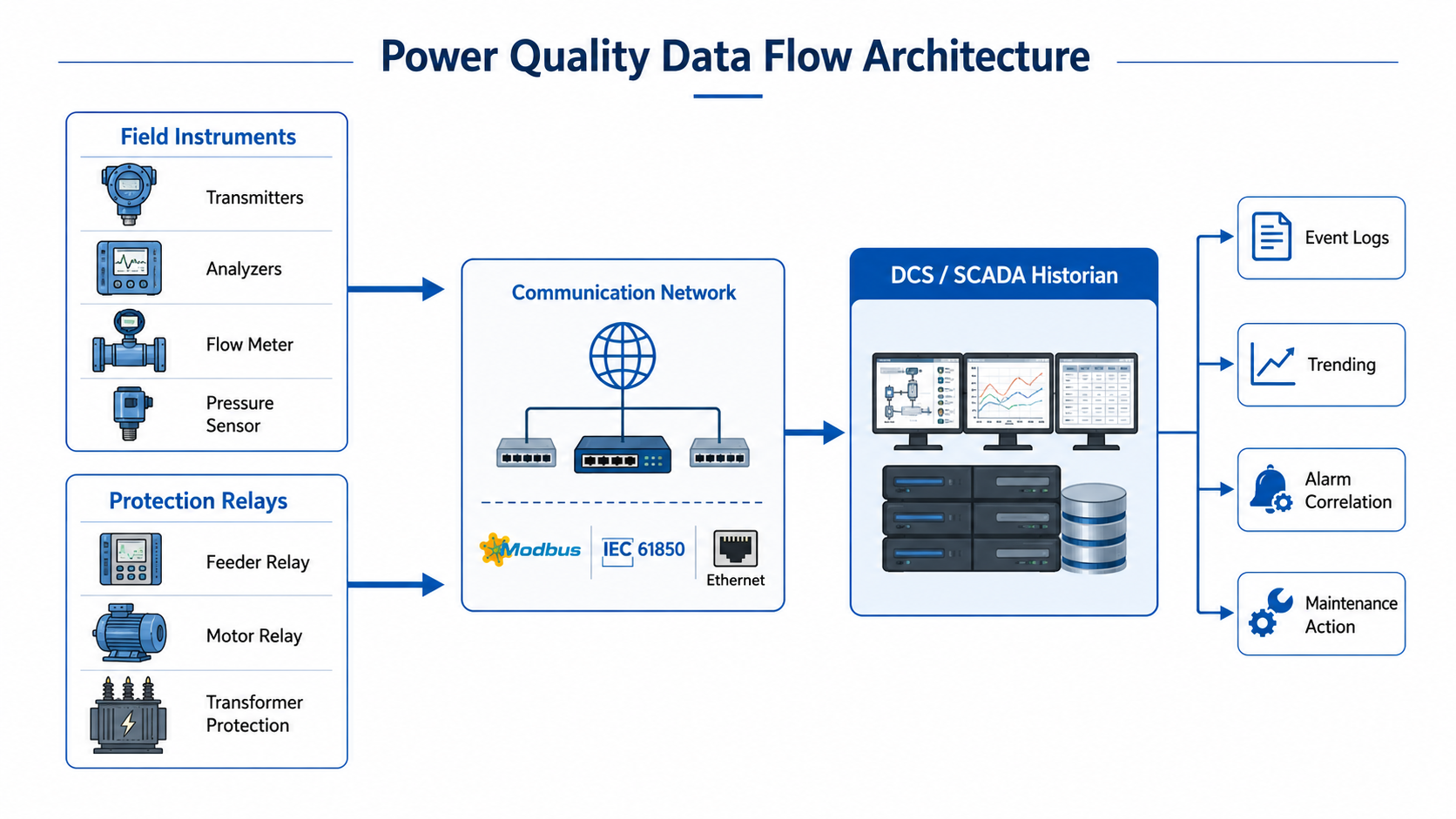
Good DCS power quality practice brings electrical data into the historian. Protection relays, power quality analyzers, smart meters, and UPS monitors can send event records, fault values, status, and waveform data through IEC 61850, Modbus, or other site protocols. Operators can then compare a pressure excursion, compressor trip, or analyzer fault with electrical events from the same timestamp.
The common gap is visibility. Many plants have capable relays and meters, but the data stays inside electrical panels. Operations teams troubleshoot a “bad transmitter,” while the root cause may be a sag on the instrument supply panel or common mode noise from poor bonding.
An integrated electrical control and instrumentation solution is essential here because refinery electrical control depends on power distribution, instrumentation, and automation data working as one operating picture. For oil gas electrical system reliability, the goal is to let electrical events appear where operations teams already review process events.
Practical Steps To Assess And Improve Power Quality On An Oil And Gas Site
A practical power quality monitoring program should start with measured data. Avoid choosing filters, SPDs, or compensation equipment only from assumptions.
Place analyzers at the main incoming supply, DCS power supply panels, major VFD groups, and main busbars. Record continuously for at least two weeks so you capture normal production, motor starts, generator transitions, switching operations, and intermittent faults.
Assess harmonic distortion. Calculate THD at key buses and compare results with the project’s IEEE 519 target or local requirement. Identify primary sources, usually large VFDs, rectifiers, UPS systems, and DC equipment. Facilities with significant VFD loads can see transformer-loss reduction after proper harmonic filtering, according to a power quality optimization guide, which reports 15% to 25% reductions in relevant cases.
Audit SPDs. Check Type 1, Type 2, and Type 3 placement, ratings, earth bonding, lead length, and visual status indicators.
Survey earthing and bonding. Verify continuity across panels, instrument enclosures, cable screens, skids, junction boxes, and control cabinets.
Rank mitigation by measured risk. Use active harmonic filters where THD is high, SVG compensation where power factor is poor, added SPDs where surge records appear, and bonding corrections where instrument noise persists.
Conclusion
Power quality monitoring is an operations risk tool. In oil and gas, poor power quality can cause instrument inaccuracy, DCS resets, unexplained trips, equipment stress, and production interruption. Your best path is to measure first, connect electrical data to process data, then target mitigation where it will improve oil gas electrical system reliability most.
For oil & gas solutions, contact CHINT for application-specific guidance. Explore oil and gas offering around stable electrical systems, automation control, process safety, reliability, smart maintenance, and connected distribution solutions for extraction and refining environments.
Frequently Asked Questions
What is power quality monitoring?
Power quality monitoring is the continuous or periodic measurement of electrical supply parameters (voltage, current, frequency, harmonic content, power factor, and transient events) to identify conditions that could cause equipment damage, process disruption, or safety incidents. A power quality monitor records these parameters over time, so engineers can identify trends, correlate electrical events with process upsets, and verify whether the supply meets applicable standards such as IEEE 519 for harmonic distortion.
What is a power quality management system (PQMS) in a substation?
A PQMS in a substation is an integrated monitoring and communication system that collects power quality data from multiple instruments and protection relays across the substation and aggregates it into a central database. It provides dashboards, alarms, and historical records for all power quality parameters. In an oil and gas context, the PQMS feeds data to the site SCADA or DCS historian, so operations engineers can correlate electrical events with process disturbances and equipment trips.
How do you measure power quality?
Power quality is measured using power quality analysers connected at relevant points in the electrical distribution system. These instruments measure voltage and current waveforms at high sampling rates, calculate parameters including THD, power factor, voltage asymmetry, flicker, and dips/swells, and record transient events with timestamps. For an initial site survey, portable analysers are used; for ongoing monitoring, permanently installed instruments are connected to the distribution network and integrated with the site SCADA or EMS.
What does a power factor of 80% mean?
A power factor of 80% (or 0.80) means that 80% of the apparent power drawn from the supply is doing useful work; the remaining 20% is reactive power that flows back and forth between the source and inductive loads (primarily motors). This reactive component increases cable current, transformer loading, and distribution losses without doing useful work. Most utilities charge commercial and industrial customers a penalty if their average power factor falls below 0.90 or 0.95. In oil and gas sites with large motor loads, power factor correction through capacitor banks or SVG compensation is an important cost reduction measure.
What are the most common power quality problems in oil and gas facilities?
The most common problems are: harmonic distortion from VFDs and large rectifiers (causing transformer and motor overheating and instrument interference); voltage sags from large motor starts or generator loading changes (causing DCS faults and drive trips); transient overvoltages from lightning and switching on long overhead distribution lines (causing equipment damage if not protected by SPDs); and voltage imbalance on systems with unequal phase loading. Earth quality issues (high earth resistance, incomplete bonding) are also common and cause significant instrument noise problems.