

For electrical power from the generating station to reach your home or business, it goes through a lot of processes involving many different parts. One of the essential parts is an electrical substation.
Its primary function is stabilizing electricity by raising or lowering the voltage as necessary for consumption. Indeed, before reaching your property, electricity flows through a lot of substations at different voltage levels. Electrical substations take energy from central stations and transform it into a form suitable for consumption.
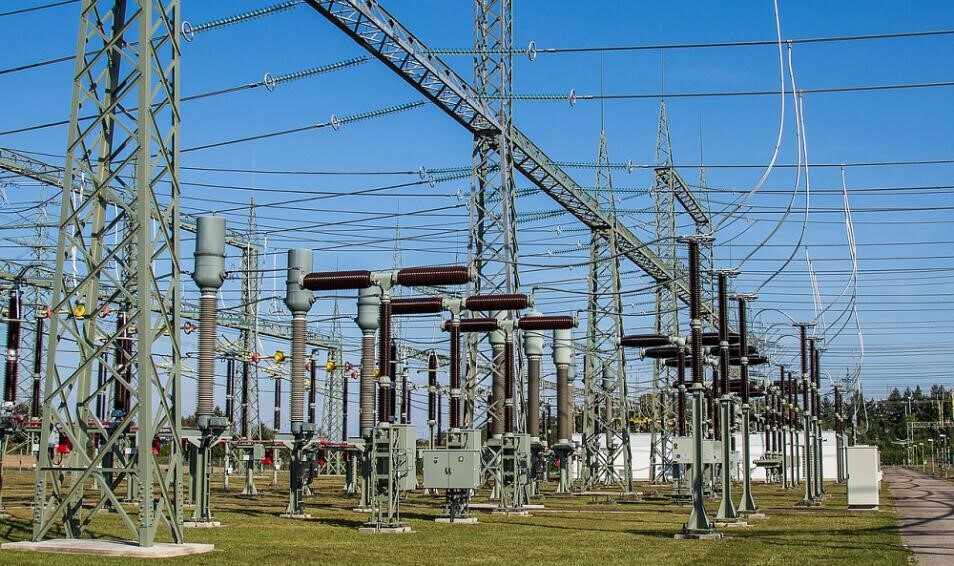
Substations comprise many different parts, but you can easily tell them by the power lines and transformers surrounded by electrical fences. There are many types of power substations. They may be properties of an electrical utility company or big commercial or industrial customers. Here is a complete breakdown.
What Are the Types of a Substation?
All substations are not the same; substations can be categorized according to the following:
- Voltage class;
- How they are used within the power system;
- How connections are insulated;
- Construction style and materials;
A transmission substation
A transmission substation is found between transmission lines. It has a transformer to change between different transmission voltages. It also has capacitors , static VAR compensators, reactors, and other power factor correction tools. Another important device in a transmission substation is a phase-shifting transformer to regulate power flow between neighboring power systems.
A transmission type substation can also be placed between two transmission lines with the same voltage; they usually contain switches that allow different lines to be connected or separated for repairs or fault clearance.

Step-down Type and step-up Substations
Step-up type substations are used to enhance voltage, making it suitable for distributing to remote locations. They are located near the electricity-producing facility. They also used to stabilize power coming to the generating facility.
On the other hand, step-down substations reduce the voltage of power going to distribution or sub-transmission lines. They can be found anywhere in an electrical network.
Distribution Substation
Distribution type substations take power from the main transmission system and supply it to consumers in the local area distribution network. The reason for the distribution type substation is because it is not economical to connect consumers directly to the main transmission network.
These substations step down high voltages to a level suitable for consumption. Any two phases will have a difference in charge equaling 400 volts; the difference in charge between any phase and a neutral will be around 230 volts. In some urban centers, there’s no enough space to construct large distribution substations, and they are therefore installed underground.
Collector Substation
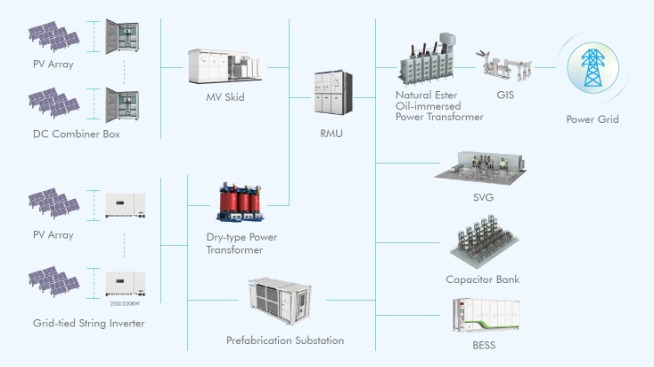
Collector type substations are used in wind power schemes and other power generating and distribution projects to channel power from turbines or inverters into the transmission grid. They operate around 12-35KV. Their main function is raising the voltage, so it is suitable for the grid. Other uses include power factor correction, controlling the power farm, and metering.
Converter Substations
Converter type substations transform electricity from alternating to direct current and vice versa. They are mainly used in traction current, HVDC converter plants, or interconnected non-synchronous networks.
Switching Station
A switching type substation, aka a switchyard, lacks transformers and operates at a single voltage level. They can be used as distribution or collector stations. They switch connections from current to back-up lines or parallelize circuits in the event of failure.
Customer Substation
Customer type substations serve as the main source of power supply for a particular business client. Their design depends on the needs of the customer.
That said, substations can also be categorized as traditional brick-and-mortar or prefabricated.
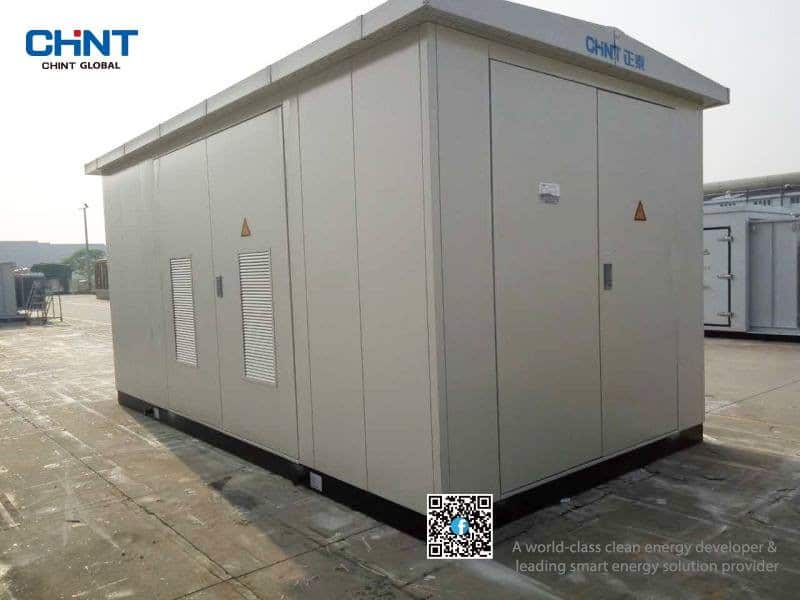
A traditional brick and mortar substation is constructed on-site, with materials brought in one by one. On the other hand, a prefabricated station comes already constructed and assembled or as finished parts, and your job is to put it together according to the manufacturer’s label of use. They are compact and easy to install and maintain.
You can order prefabricated substation from various electrical equipment manufacturers, including CHINT. They can design substations that meet local and international standards as well as your specific preferences.
What Are the Main Parts of a Substation?
Substation elements include primary power lines, overhead lines, ground wires, transformers, disconnect switches, circuit breakers, lightning arrestors, a control building, and a security fence. It’s even common practice to see substations in cities disguised as a house complete with a front walk, mown lawn and driveway, and a warning notice. Here is a breakdown of the most important part of a substation and what they do.
- Transformers convert high voltage electricity to low voltage or vice versa as necessary for consumption.
- Circuit switches control the flow of electricity.
- Breakers are used to interrupt the flow of electricity in the event of surges and thus protect your devices from damage.
- Capacitors smooth out depressions in voltage and filter out distortions, thus ensuring quality electricity.
Is It Dangerous to Live Near an Electrical Substation?
According to the Australian Radiation Protection and Nuclear Safety Agency, there is no proven evidence that living near a substation, no matter the proximity, causes health problems.
Still, some epidemiological studies say exposure to stronger than normal magnetic fields increase the danger of leukemia in kids. Still, magnetic field exposure depends on the amount of current in the substation and the distance between it and the home. Homes 5-10m and above from powerlines are not likely to have stronger than normal magnetic fields. Only worry when you live less than 5m from the substation.
Conclusion
Electricity goes through various processes before it reaches your property. Substations help make electricity suitable for consumption. They also come in handy in case of faults, allowing connections to be switched off so repairs can take place.