


Table of Contents |
Residual Current Circuit Breakers or RCCB are a very vital component for providing protection to electrical circuits. Thus RCCB electrical devices are used for sensing a leakage in the current.
It can measure the current and disconnect it from the circuit whenever there is a fault or the current goes over the sensitivity rate so that there is no electric short circuit. In Residual Current Operated Circuit Breaker you can make out if they are ON or OFF. The color green means it’s off and the color red means it’s on.
What Is RCB, RCD, RCCB or RCBO?
Let us get familiar with all four terms:
RCB
RCB or Residual Current Breaker are electrical devices that cut the current from the electrical current so as to prevent electrocution. The current leakage that it can detect is from 5 milliamperes to 30 milliamperes.
Essentially, RCB is utilized in circuits to secure human life from electric shock or electrocution. In the event that an individual is by one means or another zapped the RCB senses it and will disconnect the circuit. If some way or another an electrical equipment such as a motor or the panel gets electrified, here again, RCB disconnects the circuit.
RCD
A residual current device or RCD is a device crafted to save lives. It is designed to avoid a person from getting a deadly electric shock in the event that they touch something live, like a bare wire. It can also give some protection if an electrical fire occurs.
RCDs provide a certain amount of personal protection that circuit-breakers or ordinary fuses cannot offer. This safety device switches off automatically if a fault occurs. Thus it is basically crafted to provide protection against risks of electrocution and also against fire because of earth faults.
RCCB
Residual Current Circuit Breaker or RCCB is basically a gadget that senses current and disengages any low voltage (uneven current) circuit whenever a fault occurs. The main purpose of installing a Residual Current Circuit Breaker fundamentally is to protect people from electric shocks or death caused by them.
It avoids accidents by disengaging the main circuit just in a fraction of a second. The working of RCCB electrical devices is based on the principle – Kirchhoff’s Current Law, which means that the incoming and the outgoing current in the circuit should be equal.
RCBO
Residual Current Circuit Breaker with Over Current Protection or RCBOs are generally utilized in applications that need protection against both overcurrents that are short circuit and overload, and protection from earth leakage of current. RCBOs offer assistance in detecting such kinds of faults.
Once it finds them it trips the circuit guaranteeing the total protection of the individuals and associated equipment. It is suggested that an RCBO be connected to every separate circuit which means that if a fault occurs in a circuit it will not have any impact on the working of the other circuits.
What are the main features of RCCB?
As stated above the rccb breaker are crafted for protecting a person from the risk of being electrocuted, getting an electrical shock and from a fire which is caused because of earth faults or faulty wiring. The residual current device is very helpful especially in situations when a sudden and unexpected earth fault takes place in the circuit.
Say if a person by mistake comes in contact with a live wire if in this situation an RCCB is missing, there are chances of occurrence of an earth fault and the person can get electrocuted. Thus it is best to install an RCCB.
How does the residual current circuit breaker work?
In an ideal current the current flowing through the live wire ought to be equal to the current returning through the neutral wire. This is the principle on which the Residual Current Circuit Breaker works.
In case an earth fault occurs, the current is able to find a way to the Earth via accidental means like touching a live wire. Due to this, the returning current via the neutral wire is reduced. The difference between the two currents is called Residual Current.
RCCB is outlined in such a manner that it ceaselessly senses and compares any contrasts (residual current value) in the current between the neutral and live wires. Even a small change between the values would trigger the Residual Current Circuit Breaker and it will disconnect the circuit.
Types of RCCBs
There are two types of RCCBs, a 2 Pole RCCB and a 4 Pole RCCB:
2 Pole RCCB
It is utilized in a single-phase supply which only contains a neutral wire and a live wire. It has two ends and at those ends, the neutral wire and live wire are connected. With the help of a rotary switch, you can switch the RCCB on and off. It also has a test button that assists in periodically testing the functionality of the RCCB.
4 Pole RCCB
4 Pole RCCB is utilized in a 3-phase supply connection that includes a neutral wire and 3 phase wires. Again this has two ends where both the neutral wire and 3 phase wires are connected. This is the only difference between the 2 and 4 pole RCCB, the rest of the work is similar.
Conclusion
RCCB is a fundamental protective device that should be present in your circuit. It helps in preventing adverse situations caused because of earth faults. A good quality set of RCCBs will make sure that no one has a lethal injury because of accidents such as touching a live wire.
For the best quality RCCBs that will ensure the highest level of protection, you should opt for CHINT RCCB. CHINT has been in this business for over 30 years now and has a number of customers all over the world that trust the brand blindly.
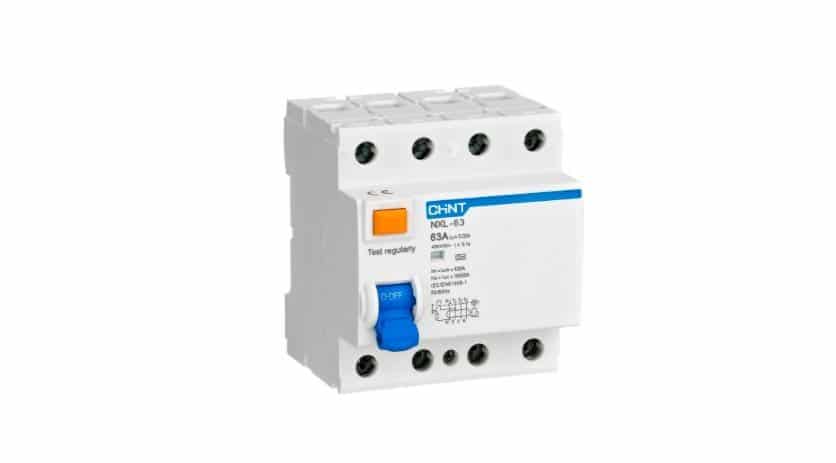
Their RCCB options such as the NXL-63 Residual Current Operated Circuit Breaker , and NL1 Residual Current Operated Circuit Breaker without Over-current Protection (Magnetic) and various other options make your home electric shockproof.