

Table of Contents |
Homeowners can choose to complement the electricity provided by the utility grid with solar energy to minimize energy costs. They can also choose to go full off-grid and depend only on solar energy. Whatever reason you may have to wish for solar panels, your choice is going to be guided by how much electricity a solar panel will produce.
What do the solar energy system metrics mean?
Just like every other item you purchase, there are specifications for all equipment for solar energy systems. A lot of us do not know what the metrics on solar panels mean. We tend to go for whatever has the bigger number. Some solar system equipment retailers assist in your choice-making, but still do not explain what the decision is based on.
Let’s demystify some of the common terms that are thrown around when you are inquiring about a solar panel and other solar system equipment.
Kilowatts (kW)
A watt is, basically, a standard unit of measure for electrical power generated by a solar panel or stored by a solar battery. A thousand watts make one kilowatt.
Kilowatt-hour (kWh)
The kilowatt-hour is the amount of electrical energy transferred from the solar panels to your electrical appliances after consuming 1000 watts for an hour. It is measured in Joules. One kilowatt-hour is equal to the total electrical energy of 3600 kilojoules.
Direct Current (DC)
This is the one-directional electric current that only flows from the source of energy to the appliances
Alternating Current (AC)
An alternating current is an electric current that periodically switches direction, back and forth, and changes its magnitude.
What is the average size of a solar panel?
Solar panels are made of 6 columns of 10 photovoltaic silicon cells. The square-cell columns are fitted on the panel, stacking up to a length of 65 inches and a width of 39 inches. There are other panels that are fitted with two extra six-cell columns to reach a length of 78 inches, maintaining the width.
Why does solar panel size matter?
The amount of electric energy a panel generates from solar energy depends on the number of silicon photovoltaic cells working together. The more the surface area is covered by the cells, the more photovoltaic material is exposed to the sun for electricity generation.
Each silicon photovoltaic solar panel generates about 1 kW to 4 kW of electric power. This means a residential solar panel will produce between 250 and 400 watts every hour. Depending on your electricity needs, this output can be adjusted by adding the number of solar panels.
How efficient are solar panels?
There have been huge strides made in the solar energy generation industry over the years. Solar panels have become more efficient compared to when the technology started in the 1950s.
Today, photovoltaic panels have an efficiency of over 18% and counting. The monocrystalline solar cells, which are more expensive to produce, are more efficient than the newer models of polycrystalline solar cells. But with constant advancements in technology, polycrystalline solar cells are poised to get more efficient as research and development are still underway.
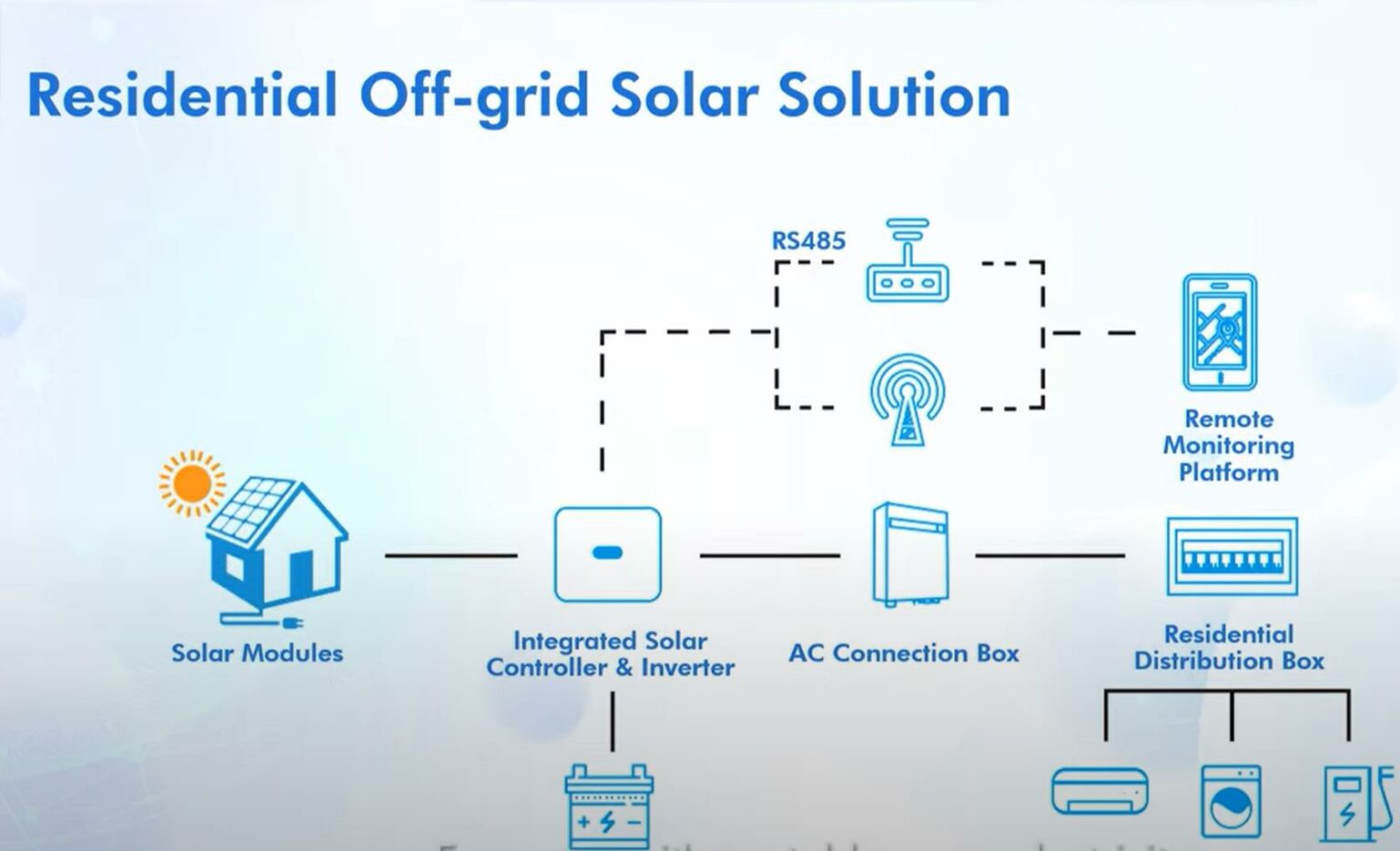
CHINT Solar Solutions.
With global energy costs going up, electricity bills have not been spared. There is a growing population of people wanting to disconnect from the utility grid and switch to using entirely solar or other green energy.
CHINT provides a full off-grid photovoltaic solution called the Off-grid PV. This is a full solar energy generation, storage, and supply for households. It is ideal for remote areas and for people escaping the high utility bills that come with grid energy. We have grown over the years to become a global giant in the industry chain of solar power generation, storage, transmission, substation, distribution, sales, and consumption. The solution comprises the following.
PV modules
PV modules are photovoltaic solar panels found at CHINT Solar Solutions. These come in three types; Monocrystalline, Polycrystalline, and BlackSerie solar panels.
Controller
A controller is a current regulator keeping the solar batteries from overcharging. It controls and regulates the current coming from the solar panels going to the battery.
CHINT controllers adopt MPPT technology, maximizing the utilization of solar panels by its high power conversion efficiency and a system efficiency of up to 95%.
Off-grid Inverter
CHINT Solar Solutions also supply Off-grid PV solutions with CPS SI series off-grid inverter, specifically designed for off-grid power system with high efficiency of up to 85%. Its excellent overload-handling capacity and protection are suitable for all electrical appliances. The inverter can withstand harsh weather conditions.
Solar controller & Inverter
CHINT Solar Solutions also supply Off-grid PV solutions with CPS SIC series off-grid inverter with an integrated design of the solar controller, inverter and isolated transformer. It adopts MPPT technology and an intelligent battery management design that has proven to be very efficient and smart.
Conclusion
We have talked about the metrics that are presented on the specifications of solar energy equipment. We have also seen how the size of the solar panels matters when buying a solar energy system for your home. It should not come around like rocket science the next time you want to make a choice on the type of solar panels to buy and where to get them.
You can make a choice to either compliment your electric grid connection with solar electricity or completely move off-grid to cheaper and clean energy from the sun.