

Introduction

Growing power demands, automation, and sensitive electronics are all making electrical protection a bigger priority, especially in the current commercial and light-industrial spaces.
With overloads, short-circuits, and leakage currents always lurking, devices like MCBs and RCCBs step in as essential safeguards. Knowing and having a deeper understanding of MCB vs RCCB helps ensure safer, steadier building systems.
Why Electrical Protection Has Become More Complex in Modern Buildings
Modern facilities don’t run like they used to, and anyone working with today’s electrical systems can feel how much more demanding things have become. Several factors now shape the growing complexity:
- Smart building devices, EV chargers, HVAC units, servers, and automation hardware pushing higher, sometimes uneven, current loads
- Bigger fault risks from load imbalance, sudden inrush currents, and insulation breakdowns
- More frequent earth-leakage issues as sensitive electronics fill every corner of a facility
- Rising expectations for electrical safety in buildings, forcing clearer decisions about what protects what
All of this means specifiers must know exactly which device tackles each hazard, making the distinction between an MCB vs RCCB more important than ever.
What MCBs Do and When They’re Needed in Commercial and Light-Industrial Installations
A Miniature Circuit Breaker, or MCB, is essentially the frontline protector against everyday electrical faults. It steps in when a circuit starts pulling more current than it should or when a short circuit hits suddenly.
Using a thermal-magnetic trip mechanism, these circuit protection devices react differently depending on the type of fault, heat for overloads, and magnetic force for those sharp short-circuit spikes.
Because of that balance, MCBs are found everywhere: tucked inside consumer units, lined up in commercial distribution boards, and guarding branch circuits across light-industrial floors.
When choosing the right MCB, specifiers usually look at a few key details:
- Rated current: often anywhere from 1–63 A
- Breaking capacity: commonly 6 kA for IEC-based installations
- Tripping curves, which mainly are:
- B-curve for lighting and lighter loads
- C-curve for motors and mixed commercial equipment
- D-curve for heavier inductive loads with high inrush
- Endurance: mechanical life, operating temperature, and overall durability
CHINT’s IEC-compliant CB series, such as the CB-60G, fits well into these environments. The CB-60G Miniature Circuit Breaker provides overload and short-circuit protection up to 415 V and 63 A, with a 6 kA breaking capacity and B/C curves that handle a wide spread of applications.
Compact, precise, and built for long service life, it’s a solid match for residential, commercial, and light-industrial distribution systems.
Where RCCBs Fit in Building Protection Strategies and How They Function
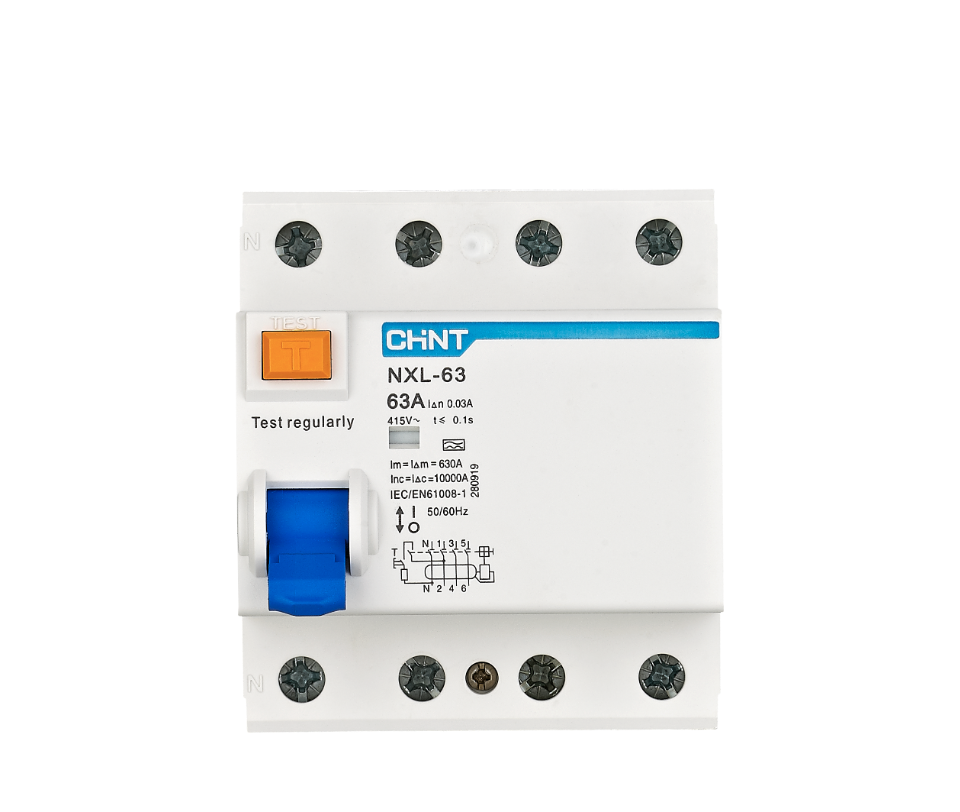
Residual Current Circuit Breakers, or RCCBs, play a very different role in a building’s protection strategy. Instead of watching for excess current, they monitor the balance between live and neutral conductors.
The moment an imbalance appears, usually caused by an earth fault, they act fast, disconnecting the circuit to prevent shock.
This is why they sit at the heart of personnel-safety planning and why many designers treat them as the backbone of overload and leakage protection schemes, especially where people interact closely with equipment.
RCCBs come in several types, each tuned to specific leakage profiles:
- Type AC: responds to sinusoidal AC leakage, common in basic circuits
- Type A: handles pulsating DC and AC, typical in electronics and appliances
- Type B: detects smooth DC and complex waveforms from VFDs, EV chargers, and industrial drives
Leakage sensitivity also varies depending on what needs protecting:
- 30 mA: enhanced personal protection
- 100/300 mA: equipment protection and fire-prevention applications
In commercial and light-industrial buildings, you’ll often see RCCBs installed in consumer units or sub-distribution panels, paired with MCBs to create a layered defense against electrical faults.
CHINT offers several options, like the following:
- NL1: a magnetic-type device for residual-current isolation
- NL210: widely used to reduce fire hazards
- NXL-63: designed for dependable shock and leakage protection
Together, these devices help keep modern installations safer and more stable.
MCB vs RCCB – What Each Device Protects and Why Both Are Needed
MCBs and RCCBs may sit side by side in a panel, but they watch for completely different problems.
One reacts to excess current that threatens cables and equipment, while the other focuses on leakage that puts people at risk. Because their roles don’t overlap, both are needed in compliant, well-designed commercial layouts.
Typically, RCCBs sit upstream, with MCBs managing branch loads downstream, forming a complete electrical protection chain.
How to Select MCBs and RCCBs for Modern Commercial & Light-Industrial Buildings
Buildings in the modern era run with a rhythm that never really stops, and the electrical systems behind that rhythm have to keep up without missing a beat.
Choosing the right MCBs and RCCBs isn’t just a box-ticking exercise anymore, as it’s a mix of practical judgment, understanding the load, and anticipating what might go wrong long before it ever does.
1. Start with a Clear Load Type Analysis
Every installation behaves differently. Resistive loads, like heating elements, run steady. Inductive and motor loads breathe in heavy inrush currents, and mixed circuits sometimes behave unpredictably. Determining these characteristics helps determine whether a B, C, or D-curve MCB fits best and prevents nuisance tripping while keeping cables safe.
2. Evaluate Short-Circuit Levels and Breaking Capacity
Commercial and light-industrial buildings often experience higher prospective fault levels because of transformer proximity, parallel supplies, or dense distribution layouts.
The MCB must have a breaking capacity, commonly 6 kA in IEC environments, that can safely interrupt the worst-case fault without welding contacts or damaging the busbar system.
3. Match the Right MCB Tripping Curve
- B-curve: suitable for lighter, resistive circuits
- C-curve: ideal for mixed commercial loads and moderate motor currents
- D-curve: for heavy machinery and high inrush equipment
Selecting the wrong curve often leads to nuisance trips or inadequate protection, so the curve must reflect the load’s behavior.
4. Choose the RCCB Type Based on Equipment Profile
Modern facilities use electronics everywhere—HVAC controls, servers, EV chargers, and VFD-driven machinery.
- Type AC works for simple, sinusoidal circuits.
- Type A handles pulsating DC produced by power supplies, appliances, and many commercial devices.
- Type B is essential wherever VFDs or EV charging introduce smooth DC or complex leakage waveforms.
5. Prioritize Selectivity and Discrimination
A well-designed protection chain won’t shut down the entire floor because one branch circuit misbehaves. Coordinating MCB ratings, curves, and RCCB sensitivity levels ensures that only the device nearest the fault trips. This keeps operations running and simplifies troubleshooting.
6. Manage Leakage Currents Across Many Circuits
With more electronics comes constant background leakage. Spreading circuits across multiple RCCBs, using appropriate sensitivity levels, and avoiding oversizing helps reduce nuisance tripping, especially in IT-heavy environments.
7. Consider Environmental and Installation Conditions
High ambient temperatures, humidity, dust, or poorly ventilated rooms require derating. Cable grouping, enclosure heat, and load cycles also influence device behavior. Selecting MCBs and RCCBs with suitable endurance ratings helps maintain reliability over years of service.
8. Ensure Compatibility with Modular DIN-Rail Systems
Most modern panels rely on modular architectures, so choosing devices that align mechanically and electrically with DIN-rail layouts speeds up installation and maintenance.
CHINT supports these selection demands with comprehensive MCB and RCCB ranges designed for modern commercial and light-industrial needs.
Circuit Protection Devices into Modern Consumer Units and Distribution Layouts
Designing advanced units and distribution layouts is almost like organizing a busy workspace; you want everything in the right spot, easy to reach, and clearly labeled so nothing gets overlooked.
A good layout usually begins with the main switch, followed by surge protection and RCCBs placed upstream, with MCBs branching out to individual circuits. Keeping critical loads, like servers or essential HVAC, separated from non-critical lighting or general sockets prevents unnecessary downtime during faults.
Coordinating earth-leakage levels is equally important; placing too many circuits under one sensitive RCCB often leads to nuisance trips. Clear labeling, accessible isolation points, and enough space for maintenance go a long way in keeping systems safe and manageable.
CHINT’s IEC-based final and secondary distribution solutions follow these principles, helping designers build cleaner, more resilient layouts.
Conclusion
Choosing the right mix of MCBs and RCCBs is more than just a technical detail, as it’s what keeps buildings safe, running, and compliant. When devices are matched properly, from short circuit protection to leakage safeguards, the entire system becomes steadier and far more dependable, supporting the demands of modern commercial and light-industrial spaces.