Please enter keywords to search

Global |EN

Choose your country & Language

Asia Pacific

Australia & New Zealand
India
Indonesia
Malaysia
Philippines
Singapore

Middle East & Africa

Kenya
Saudi Arabia
South Africa
United Arab Emirates

Europe

France
Kazakhstan
Netherlands
Spain
Italy
Turkey
United Kingdom

Latin America

Brazil
Colombia
Ecuador
Peru

North America

Canada
Mexico
United States

Choose your country & Language

Australia & New Zealand
India
Indonesia
Malaysia
Philippines
Singapore
Kenya
Saudi Arabia
South Africa
United Arab Emirates
France
Kazakhstan
Netherlands
Spain
Italy
Turkey
United Kingdom
Brazil
Colombia
Ecuador
Peru
Canada
Mexico
United States

Please enter keywords to search

Your search term contains restricted words. Please use different keywords.
DTSU666
DTSU666

DTSU666

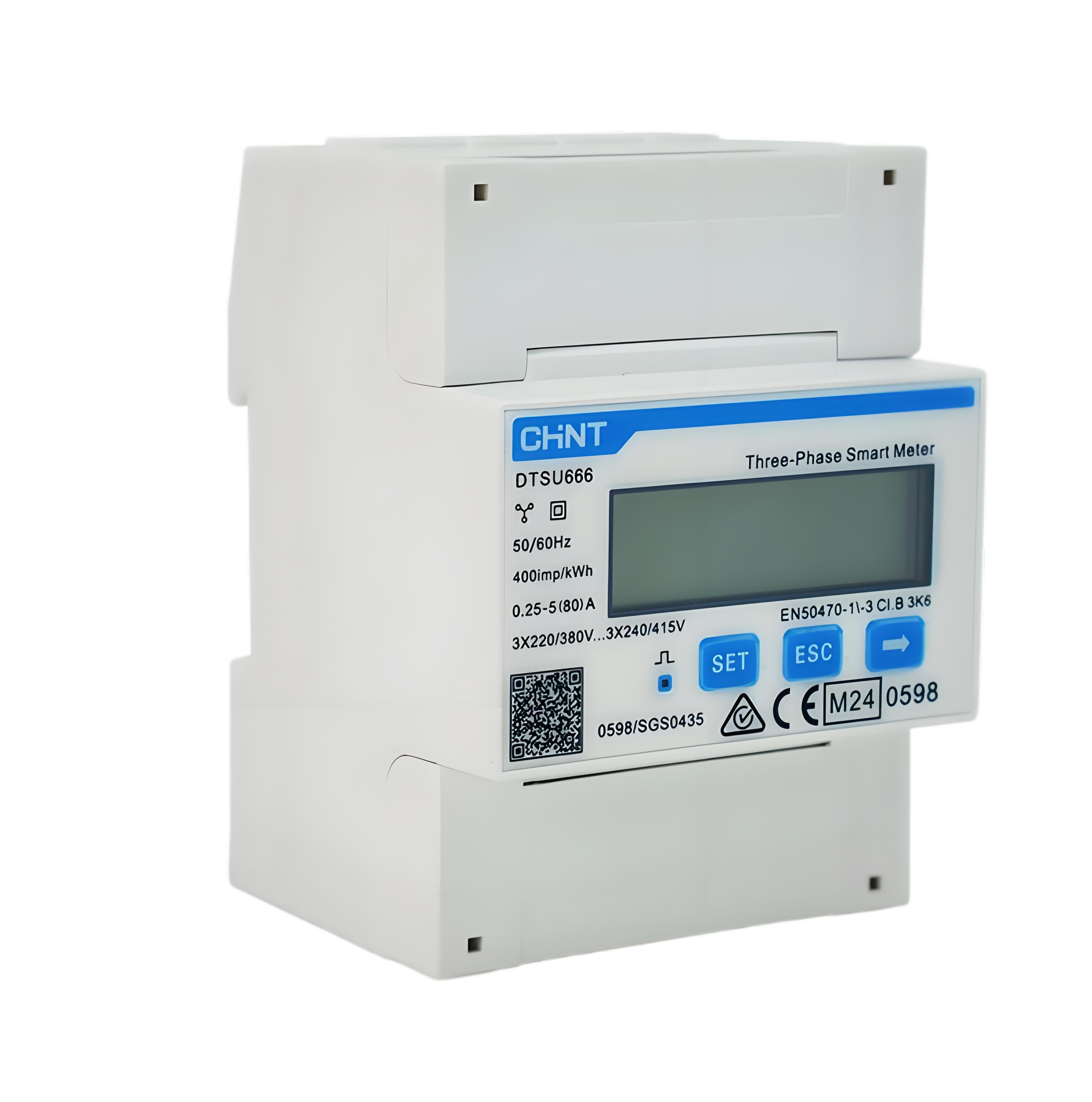
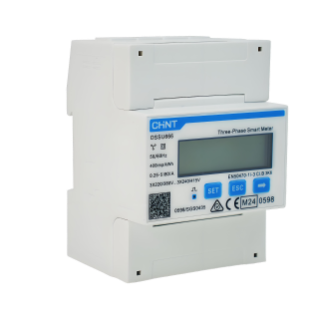
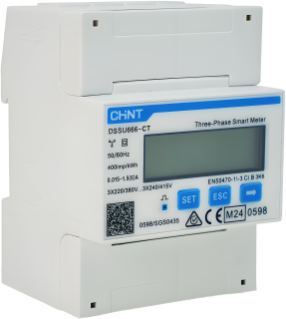
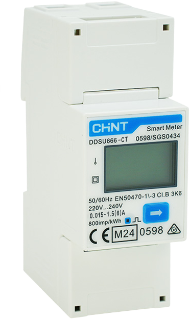
The CHINT DTSU666 is a compact, three-phase, four-wire smart energy meter for precise power monitoring in industrial, commercial, and renewable installations. Certified to EN 50470-1/-3 MID Class B / 1.0, it measures voltage, current, power, frequency, power factor, and bi-directional energy. Featuring RS485 Modbus-RTU communication, it integrates easily with building and energy management systems. Housed in a DIN-rail IP20 enclosure, it includes a backlit LCD display and LED pulse indicator. With an operating range of 3×220/380V to 3×240/415V and 0.25–5(80)A, it ensures high accuracy, low power use, and quick installation for reliable sub-metering and solar monitoring.

Product Information

Recommend Blogs
APRIL 15, 2026 Why MCCBs Are Critical for Industrial Safety and Compliance at High Voltage Levels

Does your facility operate with high-voltage industrial applications? Learn how an MCCB can promote electric safety and minimize production downtime in this comprehensive guide.

APRIL 14, 2026 Creating Energy-Efficient Electrical Installations

Learn how final distribution boards, smart meters, and proper electrical installation design work together to create energy-efficient homes that reduce power waste.

APRIL 14, 2026 Selecting the Appropriate Circuit Breaker for Residential and Industrial Applications

Proper circuit breaker selection entails understanding of circuit breaker types and important selection factors to consider. Learn more in this article.

APRIL 14, 2026 RCCB Tripping Explained: Causes, Nuisance Tripping, and Electrical Fault Diagnosis

In this article, we explain the role of RCCB tripping in electrical safety and what causes unintended or nuisance tripping.

APRIL 14, 2026 Why OEMs Are Standardizing on Modular Breaker Platforms

Learn why OEMs adopt modular circuit breaker platforms to cut engineering time, boost design flexibility, and streamline industrial projects.

APRIL 14, 2026 Why Modular Electrical Solutions Offer Faster ROI

Discover how modular electrical systems and prefabricated LV/MV solutions deliver faster ROI through reduced timelines and predictable costs.

APRIL 14, 2026 How to Plan a Fuse Box Upgrade: Costs, MCB Installation, and Safety Benefits

A fuse box upgrade is essential to ensure that your consumer unit can keep up with your current power demand and electric safety needs. Learn more in this article.

APRIL 13, 2026 Common Wiring Mistakes That Reduce Safety in Homes

How do hidden home wiring mistakes impact safety, and why electrical compliance matter? Learn how correct MCB selection reduces risk in modern homes and long-term reliability.

APRIL 13, 2026 How to Install and Use Your Home EV Charger Safely

Learn how to safely manage home charging with expert tips on EV charger installation, daily use, and protective measures for reliable, stress-free charging.

MARCH 10, 2026 How Surge Protective Devices (SPDs) Keep Your Small Business Equipment Safe

Learn how surge protection and electrical protection strategies support small business power needs, reduce downtime, and keep equipment reliable as demand grows.

Need Support From Us?

Blog
Blog

Find expert perspectives on the trends and technologies driving your business.

View Now
Download Center
Download Center

Download new and previously released documents including product document, solutions, cases, coporate report.

View Now
Contact Us
Contact Us

Reach out to us to receive more information, technical support, assistance with complaints and more.

Get Support
Collapsed
Expand

FAQs


What is the main difference between the DTSU666 and the DTSU666-CT models?

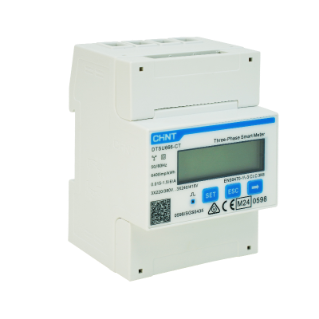
The DTSU666 is a direct-connected meter rated for up to 80A, suitable for small to medium loads. The DTSU666-CT version is designed for current transformer (CT) input, making it ideal for higher-capacity installations or when direct connection is impractical. Both models share the same communication, accuracy, and display features.


Can the DTSU666 be used for both import and export energy measurement?

Yes. The DTSU666 provides bi-directional measurement for import and export kWh/kvarh, making it suitable for applications such as solar PV systems, where energy flows in both directions between the grid and the installation.


What communication protocol does the DTSU666 use?

It communicates via RS485 using the Modbus-RTU protocol. This allows easy integration into energy management, BMS, or SCADA systems. The baud rate is configurable from 1200 to 19200 bps (default 9600 bps).


How can I view and verify real-time electrical parameters?

All measurements—including voltage, current, active/reactive power, power factor, frequency, and total energy—are shown on the backlit LCD display. The display cycles automatically through parameters or can be navigated manually using the front panel buttons.


What are the installation and environmental requirements?

The meter mounts on a 35mm DIN rail and requires a 3-phase, 4-wire connection. It operates reliably within –25°C to +55°C, with ≤95% relative humidity, and offers an IP20 protection rating, making it suitable for indoor electrical panels or enclosures.