

Table of Contents |
Power Distribution Units (PDUs) play a crucial role in maintaining consistent and reliable power distribution in data centers, ensuring the smooth operation of mission-critical equipment. A PDU is a sophisticated device that goes beyond the capabilities of a power strip, intelligently managing and distributing electricity to multiple servers or IT equipment. As an integral part of a data center’s infrastructure, PDUs help balance power loads and are available in various types to suit specific applications.
Understanding Power Distribution Units (PDUs)
PDUs are a critical component in data centers, responsible for managing and distributing electrical power to IT equipment. These advanced devices, often mounted on racks, cater to power requirements significantly larger than conventional power strips. PDUs ensure the adequate powering of an organization’s IT infrastructure while monitoring power efficiency and uptime.
With the global PDU market expected to reach $1.6 billion by 2028, understanding the various types of PDUs available is essential to determine the best solution for your data center needs.
Basic
A basic PDU is an entry-level solution for delivering reliable power to critical IT equipment within a rack or cabinet. Resembling a conventional power strip, basic PDUs provide a cost-effective option for smaller server rooms with on-site IT staff. These units may include features such as locking receptacles to prevent accidental disconnections and the potential for future smart capabilities. However, basic PDUs lack remote management and monitoring functions.
Metered
A step up from the basic PDU is the metered PDU. This provides the same features as the basic PDU with the added advantage of being able to see local power consumption data. You can view this via the local display and gain insight into the power usage of your equipment. You’ll get to view data like power factor, voltage, current, and more. This will help your staff assess your current needs and know when upgrades are necessary.
Monitored
Monitored PDUs will provide the same features as the metered PDU, with the added exception of remote monitoring over the network. This lets authorized users remotely access real-time data about your PDU’s power consumption metrics, even down to the individual outlet. This is ideal for receiving automatic alerts when thresholds are exceeded and understanding your power usage with greater precision.
Switched
A Switched PDU is an advanced solution offering the highest level of smart capabilities for data center power management. In addition to monitoring features, switched PDUs enable authorized personnel to remotely control individual outlets, turning equipment on, off, or rebooting unresponsive devices via an intuitive web interface.
These units also prevent overloads by limiting power usage at the outlet level, ensuring optimal power efficiency and availability. Suitable for both large-scale data centers and remote locations without on-site IT staff, switched PDUs provide unparalleled control over data center power management.
Factors to Consider When Buying a PDU Power Distribution Unit
Selecting the ideal PDU for your data center involves considering numerous factors to ensure optimal performance and efficiency. To begin, assess the number, size, and types of outlets required for your specific setup, as each PDU offers varying outlet configurations.
Next, determine the optimal mounting location for your PDUs, taking into account your existing equipment setup. Horizontal and vertical mounting options are available, with each offering unique advantages. Horizontal PDUs are restricted by the width of your rack, while vertical installations typically accommodate more outlets due to their access to various rack levels.
Remote access is another crucial aspect to consider when choosing a PDU. Metered and switched PDUs provide remote monitoring capabilities, but with varying degrees of control. If on-site monitoring is sufficient, a metered PDU may be suitable. However, if your IT personnel require remote control over your PDUs from any location with internet connectivity, a switched PDU is essential.
After determining the required outlets, power specifications, monitoring needs, and mounting options evaluate the scalability of your chosen PDU and its compatibility with your budget. Ensuring that your PDUs can accommodate your company’s growth is vital, as purchasing additional units in the near future due to a lack of foresight can be costly. Furthermore, as with any investment, it is crucial to select a PDU that fits within your allocated budget.
By carefully considering these factors, you can make an informed decision when purchasing a PDU that meets your data center’s specific requirements, ensuring efficient power management and distribution for your mission-critical equipment.
Related Article: Why is PDU Important in Data Centers?
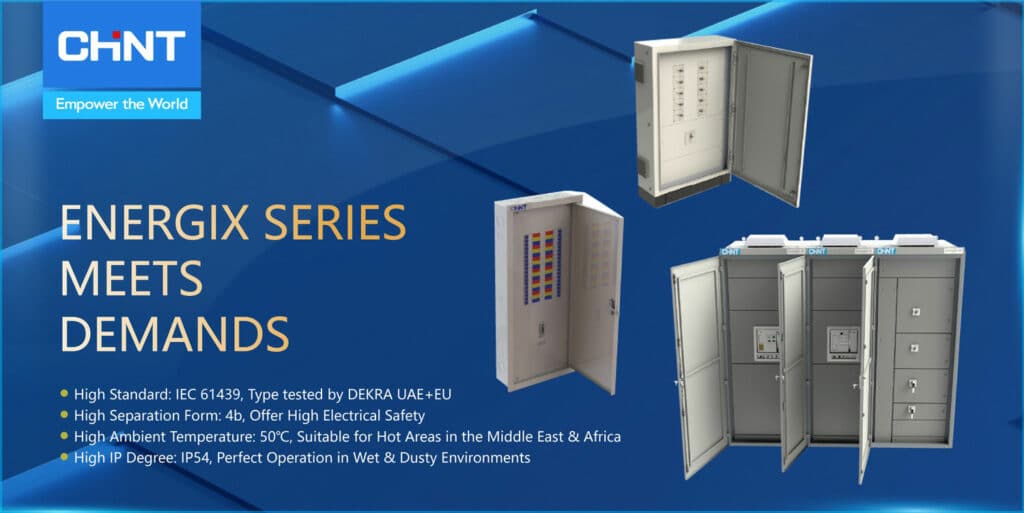
Chint Global's EnergiX-P40 Low-voltage Power Distribution Unit for Server Rack
Chint Global’s EnergiX-P40 is a low-voltage Power Distribution Unit (PDU) designed for data centers, offering advanced monitoring capabilities and enhanced energy efficiency. This robust PDU provides exceptional protection against power outages and service interruptions by preventing overvoltages and overcurrents.
Equipped with IEC 61439 type test certification and IEC 60068 semi-report, the EnergiX-P40 boasts live-swappable outgoing circuits and a modular layout, enabling improved hardware management and increased capacity for multiple-circuit operation.
The intelligent monitoring system allows for remote management of security, maintenance, and circuit electrical data. With simple installation and compatibility with most standard server rack setups, this cost-effective PDU is ideal for data centers seeking reliable power distribution.
Key features include a rated current of 400A/200A, rated power capacity of 277kVA@400V/138kVA@400V, and an operating temperature range of 0°C to 40°C. The unit measures 2200x1100x600mm and weighs 450kg, offering a durable solution for data center power distribution.
Tips for Installing and Maintaining Your Power Distribution Unit
Installing and maintaining a PDU in your data center is crucial for ensuring reliable and efficient power distribution. Here are some tips to guide you through the process:
Installation:
- Align the vertical-mounting brackets.
- Attach the brackets to the PDU.
- Connect the power cord, and route it securely to its power source.
- Secure the power cord with cable straps.
- Connect the servers or rack devices to the outlets on the PDU.
Testing & Maintenance:
- Perform acceptance testing on all new installations to ensure reliability and safety before startup.
- Conduct periodic inspections, focusing on components, wiring, and connections for signs of overheating or loose bolted connections.
- Carry out electrical tests on circuit breakers, isolation transformers, PDU bus, grounding, metering, instrument transformers, and surge arresters.
- Perform system function tests to verify the correct interaction of all sensing, processing, and action devices.
- Consult the manufacturer’s literature for specific device testing procedures.
In addition to these tests, a thorough visual and mechanical inspection should be carried out, and the unit should be cleaned periodically. Remember to always de-energize equipment and use qualified testing agencies with certified test technicians for conducting tests. Following these tips will help ensure the optimal performance and longevity of your PDU.
Conclusion
Investing in a reliable and efficient PDU, such as Chint Global’s EnergiX-P40, is critical for managing and distributing power in your data center. You can ensure optimal performance and longevity by understanding your specific needs, carefully considering the factors mentioned above, and following best practices for installation and maintenance. Trust Chint Global for your PDU requirements and experience the benefits of advanced monitoring capabilities and enhanced energy efficiency.