

In 2021, President Xi Jinping delivered an important speech at the Leaders' Summit of the 15th meeting of the Conference of the Parties to the Convention on Biological Diversity (COP15), noting that "Lucid waters and lush mountains are invaluable assets. A sound ecological environment is both natural and economic wealth, bearing on the potential and sustainability of economic and social development. We need to accelerate the formation of a green development model, promote a win-win outcome between economic development and environmental protection, and build a global home where the economy and the environment advance in synergy."
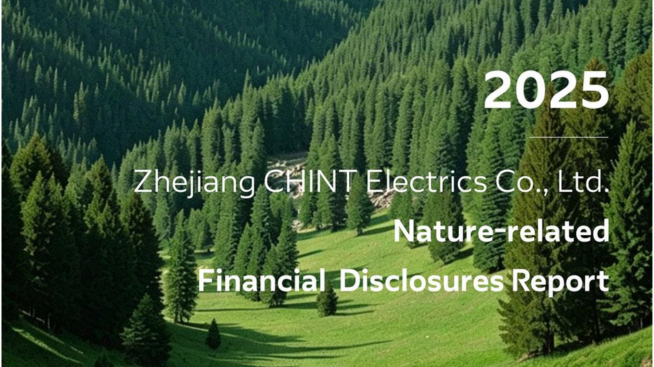
Currently, biodiversity loss and ecosystem degradation are intertwined, posing systemic challenges to global economic and social development. CHINT Electrics deeply recognizes the critical role of natural capital in the long-term development of enterprises. Recently, the Company released its inaugural *Nature-related Financial Disclosures Report*. Prepared in accordance with the four core elements of Governance, Strategy, Risk & Impact Management, and Metrics & Targets, the report systematically elaborates on the Company's work arrangements and practical outcomes in nature-related management, demonstrating the Company's sense of responsibility in practicing the green development philosophy and promoting harmonious coexistence between humanity and nature, and bolstering sustainable development through reliable practices.
What is TNFD?
The Taskforce on Nature-related Financial Disclosures (TNFD) was officially launched in 2021. It aims to help enterprises systematically identify and manage nature-related dependencies, impacts, risks and opportunities by developing a nature-related disclosure framework.
CHINT Electrics' inaugural Nature-related Financial Disclosures Report is primarily prepared with reference to the Recommendations of the Taskforce on Nature-related Financial Disclosures (TNFD) Version 1.0, and systematically conducts LEAP (Locate-Evaluate-Assess-Prepare) analysis in accordance with the Guidance on Identification and Assessment of Nature-related Issues: The LEAP Approach Version 1.1 released by TNFD, reflecting the Company's unwavering determination and confidence in pursuing nature-positive development.
Governance
Leveraging its ESG system, CHINT Electrics integrates nature-related issues into the core areas of sustainable development management, and has built a three-tier governance system covering the governance level, management level and implementation level, earning trust from all parties with reliable governance capabilities.
- Governance Level: The Board of Directors oversees the strategic direction and major decision-making on nature-related issues. The Strategic and Sustainability Committee, established under the Board of Directors, assists in the review, supervision and decision-making processes.
- Management Level: The Sustainability Office is responsible for implementing decisions and deployments, breaking down strategic plans, and organizing training programs and report preparation.
- Implementation Level: Responsible for carrying out work in accordance with the TNFD framework, and launching public welfare projects that facilitate ecological protection and climate change mitigation.
Meanwhile, the Company attaches great importance to stakeholder engagement and has established a regular material issue assessment mechanism. In 2025, the Company identified a total of six environment-related material issues, including climate action and energy utilization.
Strategy
Based on the LEAP methodology (Locate-Evaluate-Assess-Prepare) recommended by TNFD, CHINT Electrics has conducted a systematic assessment of the interactions between its six major manufacturing parks in Chinese mainland and natural ecosystems, providing a basis for strategic decision-making through scientific and rigorous analysis.
- Locate Phase: Using tools such as the Biodiversity Impact Assessment (BIA) tool and WRI Aqueduct, the Company assesses whether its six major manufacturing parks are located in protected areas, key biodiversity areas and water-stressed regions, so as to identify ecologically prioritized sites.
- Evaluate Phase: Assessment via the Exploring Natural Capital Opportunities, Risks and Exposure (ENCORE) tool shows that the Company's manufacturing business as a whole has a relatively low degree of direct dependency on natural ecosystem services and environmental impact. The Company has a moderate level of dependency on ecosystem services such as water supply and rainfall pattern regulation. The discharge of toxic pollutants into water bodies and soil is identified as a potential environmental impact requiring priority management.
- Assess and Prepare Phase: By drawing on the scenario analysis approach of TNFD, the Company identifies potential nature-related risks and opportunities that may affect the business. It further validates and improves the analysis results through internal interviews, and formulates management actions based on the findings to optimize and enhance the Company's management and response capabilities.
Risk & Impact Management
CHINT Electrics continuously tracks the evolving trends of nature-related risks and opportunities, gradually improves relevant management mechanisms, and explores the integration of nature-related risks into the Company's overall risk management framework. Through the closed-loop management of "identification-assessment-response-tracking", it has formulated a systematic list of risks and opportunities, and carries out actions from four dimensions: Avoid, Reduce, Restore & Regenerate, and Transform, giving priority to avoiding and reducing impacts on the natural environment.
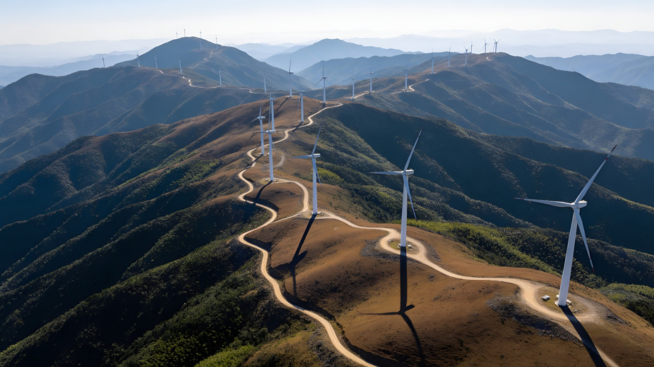
- Avoid: For project site selection, priority is given to barren hills and slopes, ponds and water surfaces to avoid ecologically sensitive areas. Environmental impact assessments are conducted in accordance with the law before construction to minimize ecological disturbance.
- Reduce: 100% of the Company's major production bases are certified under ISO 14001. In product research and development, environmentally friendly materials are prioritized to reduce negative impacts at the source.
- Restore & Regenerate and Transform: The Company actively explores eco-synergy models such as "PV + agricultural planting" and "PV + fishery breeding". Among them, the Wenzhou Taihan 550MW Solar-Fishery Complementary Project is the largest offshore tidal flat solar-fishery project in Asia, which is expected to reduce carbon emissions by approximately 650,000 tons per year.
Metrics & Targets
Based on the assessment of dependency and impact on the natural environment, and in alignment with the Group's sustainable development strategy, CHINT Electrics has formulated highly targeted and actionable nature-related targets, and established a multi-dimensional monitoring indicator system to continuously track progress and drive optimization and improvement. Selected targets are as follows:
- Greenhouse Gas Emissions: From the 2024 baseline, reduce absolute greenhouse gas emissions of Scope 1 and Scope 2 by 58.8% by 2034.
- Water Resources: From the 2024 baseline, achieve a 10% reduction in water use intensity by 2035.
- Green Products: From the 2022 baseline, increase the number of green design/product carbon footprint certifications for core products by 50% by 2030.
- Biodiversity Conservation: Achieve no net loss of biodiversity in direct operations by 2040, and develop solutions and technologies that contribute to biodiversity conservation.
In 2025, the Company's waste recycling rate reached 88.95%, revenue from the photovoltaic business accounted for approximately 61% of the total, and environmental protection investment exceeded RMB 2 million.
The release of the 2025 Nature-related Financial Disclosures Report is an important measure for CHINT Electrics to practice the sustainable development philosophy and implement the requirements of the TNFD framework, marking a new phase of systematic and standardized development for the Company's nature-related management.
Going forward, CHINT Electrics will continuously track nature-related risks and opportunities, improve its management mechanism, integrate natural risks into the overall risk control framework, and promote the coordinated advancement of business development and ecological protection. With sustained and reliable actions, the Company will live up to the trust and expectations of customers, investors and all sectors of society.