

Table of Contents |
Dust poses a serious threat to circuit safety and reliability in many industrial workplaces. In mining, food processing, and chemical manufacturing, airborne particulates accumulate easily. Over time, unchecked dust intrusion can degrade AC contactor performance through overheating, blocked airflow for cooling, and contaminated electrical connections.
These situations significantly shorten equipment lifespan and increase failure risks, potentially causing costly downtime, damage to assets, or dangerous conditions. Effective protection is needed to protect operations, especially for critical machinery circuits. A dust-proof contactor provides sealed protection that prevents dust intrusion and the associated issues. It offers reliability and peace of mind for applications in challenging environments.
The Hazards of Dust in Industrial Environments
Dust poses numerous threats to electrical equipment over time. Finely powdered particulates rapidly accumulate on AC contactor surfaces. The insulating layer inhibits heat dissipation, raising operating temperatures beyond equipment limits. Repeated overheating stresses materials, reducing switch capacity and shortening AC contactor lifespan. Dust also restricts the airflow necessary to cool internal components. If untouched, performance steadily declines until failure occurs prematurely.
Common circuit failures from dust include an increased risk of arcing, sparks, and overloading. Frequent arcing events increase fire hazards, especially where combustible dust is involved. Equipment that malfunctions or shuts down unexpectedly also endangers workers. Some specific failures and their consequences include:
Erratic switching from contaminated contacts causes intermittent power disruptions, slowing production output.
Short circuits and blown fuses from conductive dust bridging live pins overload the circuit.
Overheating of compressed dust layers ignites nearby combustible materials like solvents.
Tripped circuit breakers and damaged wiring from overload conditions during critical processes.
Safety shutdowns and lockouts increase repair time compared to scheduled servicing.
Effective sealing is hence required to prevent dust from degrading contacts and to increase dangerous failure incidents over the long-term use of contactors in industrial settings.
Design and Functioning of Dust-proof Contactors
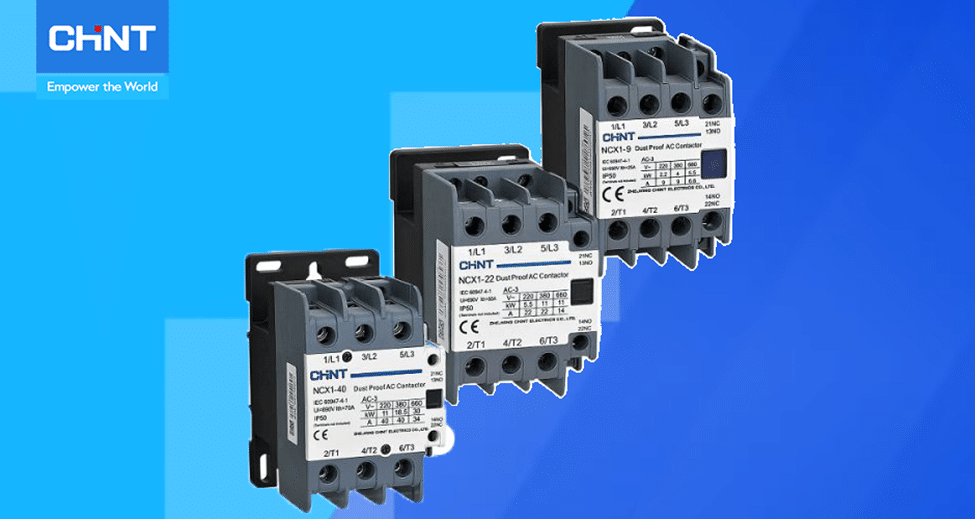
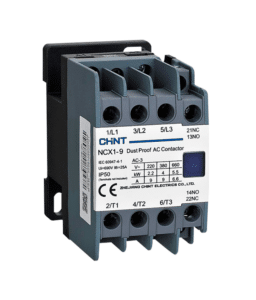
A quality dust-proof contactor counters dust intrusion through a unique design that effectively seals the contact points from external contaminants. The CHINT NCX1 Series features a “Gate-type” dust-proof design, which includes a dust-proof cover that covers all the terminal parts of the wiring. This gate design seals off the dust from the outside and is constructed to be completely sealed around the edges, providing a high level of protection against dust accumulation.
Demonstrating the effectiveness of this design, when compared with a regular contactor under the same dust conditions, the internals of the regular contactor may become filled with dust, potentially blocking its contacts and hindering its functionality. However, the NCX1 Series dust-proof contactor, despite any external weathering, maintains a clean interior. This design allows the contactor to achieve an IP50 protection rating, which means it is dust-protected but not fully dust-tight.
In addition to its dust protection capabilities, the NCX1 Series dust-proof contactor also enhances performance by increasing the heating current by 25%. This improvement not only contributes to better resistance against dust-related issues but also boosts the operational efficiency of the AC contactor.
A reliable dust-proof contactor like the NCX1 enhances safety, efficiency, and productivity across many industrial operations. It improves reliability for applications involving:
Food processing machinery, which requires stringent sanitation in dusty environments.
Mining equipment operating in air filled with mineral particulates.
Pharmaceutical/chemical manufacturing needs protection from contamination risks.
Cement and stone production involving finely powdered materials.
Additional benefits of a dust-proof contactor include increased uptime through the prevention of AC contactor failures and reduced costs versus frequent repairs or replacements.
Best Practices for Selecting and Maintaining Dust-proof Contactors
Selecting the right dust-proof contactor is important for achieving maximum circuit protection and service life. Key application variables must align with contactor specifications. Parameters to consider include:
The rated switching capacity matches the intended load
Voltage rating meets distribution system voltage
Temperature range includes process temperatures
IP/NEMA rating fits site conditions
Closing type – electromagnetic or thermo-magnetic – for control functions
Proper maintenance and servicing further ensure the reliable long-term performance of a dust-proof contactor. Regular visual inspections can identify issues like loose terminals requiring tightening before escalating. For installations with heavy accumulations, cleaning exterior surfaces removes debris buildup. Over time, naturally worn components affecting sealing integrity or electrical properties should be replaced proactively. Changing out contactors exhibiting decline prevents potential failure modes from developing during critical processes.
Conclusion
In summary, dust exposure presents ongoing risks to circuit dependability in industrial settings that conventional contactors cannot fully mitigate. Over extended periods, airborne particles overwhelm standard contactors, shortening their usable lifespan. Dust-proof contactor options like CHINT’s NCX1 Series address this challenge through fully encapsulated construction that stands up to punishing environments. The NCX1 protects electrical systems against dust intrusion and its associated issues, ensuring circuits powering vital processes operate reliably for years. For applications mandating protection from dust hazards and maximum lifecycle costs, the product represents an intelligent investment choice. Visit CHINT’s website to learn more about our product portfolios.


-metalclad-AC-enclosed-switchgear-banner.png)