

Table of Contents |
Gas meters are very important devices that measure how much gas is normally used in our home or establishment each billing period. To put it in other words, it counts the flow inside a gas compartment as it empties and fills itself, allowing you and your provider to keep track of your consumption rates.
How to turn on gas meter
Gas meters and shut-off valves may be hard to locate for some beginners, let alone operate.
However, if you’re a household or establishment owner, this knowledge is crucial in the event that you need to perform an emergency safety action. This information will allow you to take control of strenuous situations involving a possible gas leak or a break in the line, just to give a few examples.
In truth, since not all gas systems work the same way, there may be a steep learning curve ahead. Some elements need to be factored into the assessment, such as the age of your structure.
Older homes in many locations don’t even have gas shut-off valves, while apartment buildings may contain individual valves for each apartment and a master valve for the entire complex.
In any case, the most common types of systems have their valves situated somewhere around the black iron pipe that feeds gas into the property. The valve should be found along the supply line.
The “on” position is parallel to the pipeline, while the “off” position is perpendicular (a 90º turn). In some instances, you would have to use a wrench or similar tool to adjust this valve, particularly if it lacks a handle.
When you move into a new home, you’ll likely have to manually turn on the gas meter located on the side of the street, which feeds the household meter. The streetside meter would be usually placed at the front or side of the house, within a metal box.
Adjacent to the meter, you’ll find the valve handle, which is turned in the same directions described before, relative to the pipe (parallel is “on” and perpendicular is “off”).
The meter dial will move and stop after fifteen seconds, provided that you don’t have a gas appliance turned on or there is no leak in the system (which would be the worst-case scenario).
Before proceeding in each case, you ought to make sure that all gas-powered appliances and pilot lights are turned off.
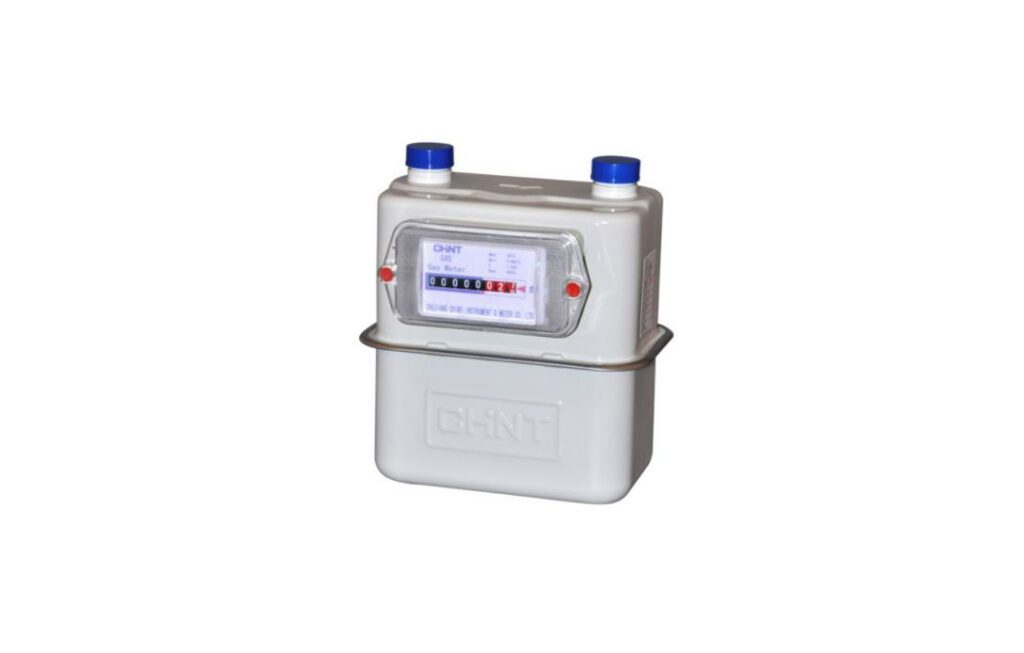
How does a diaphragm gas meter work?
The diaphragm meter is a positive displacement flow meter (meaning that it requires fluid to operate) that measures the volumetric flow of gas through oscillating diaphragms contained in a series of chambers of known volume.
The diaphragms expand and contract with each gas inflow, triggering a counter mechanism (either digital or analog) via a series of cranks attached to a crankshaft.
The crankshaft is set into rotary motion by interaction with the diaphragms and serves to drive an odometer counter or, in more modern devices, to produce electrical signals that are sent to a flow computer with the aid of a pulse generator. which in turn calculates the total flow.
In meters operating with a flow computer, the pulse count is stored in a pulse data logger, which will then render a reading. This data will be collected by the service provider for billing purposes.
The meters only measure volume and do not take into account the pressurized quantity. The volumetric flow rate is defined with each filling/emptying cycle.
Diaphragm meters are some of the oldest gas meters in existence, going back to 1844’s England. The first meter had a couple of round leather diaphragms with sliding valves and measured gas by dividing gas flow in volumetric increments.
Diaphragm vs rotary gas meter
In contrast to diaphragm meters, rotary gas meters function by way of “8”-shaped rotors or pistons that are set at a 90º angle one to the other under the action of timing gears.
These rotors are set into motion by the gas flow and spin in opposite directions inside a cylinder of known volume. As the known volume is discharged from one rotor, a portion of gas with a similar volume gets alternately trapped by the other rotor.
The volume measurement is done by multiplying the displaced gas per revolution by the number of revolutions made by the pistons during the process. A gear reduction system, then, totalizes the displaced gas and feeds the reading instrument.
Apart from the differences in mechanism and overall structure, rotary meters are designed to handle higher pressures and volumes than the traditional diaphragm meters. Nonetheless, they’re not equipped to handle low-flow conditions as well as their diaphragm counterparts, so they’re marketed mostly for industrial or commercial rather than residential use.
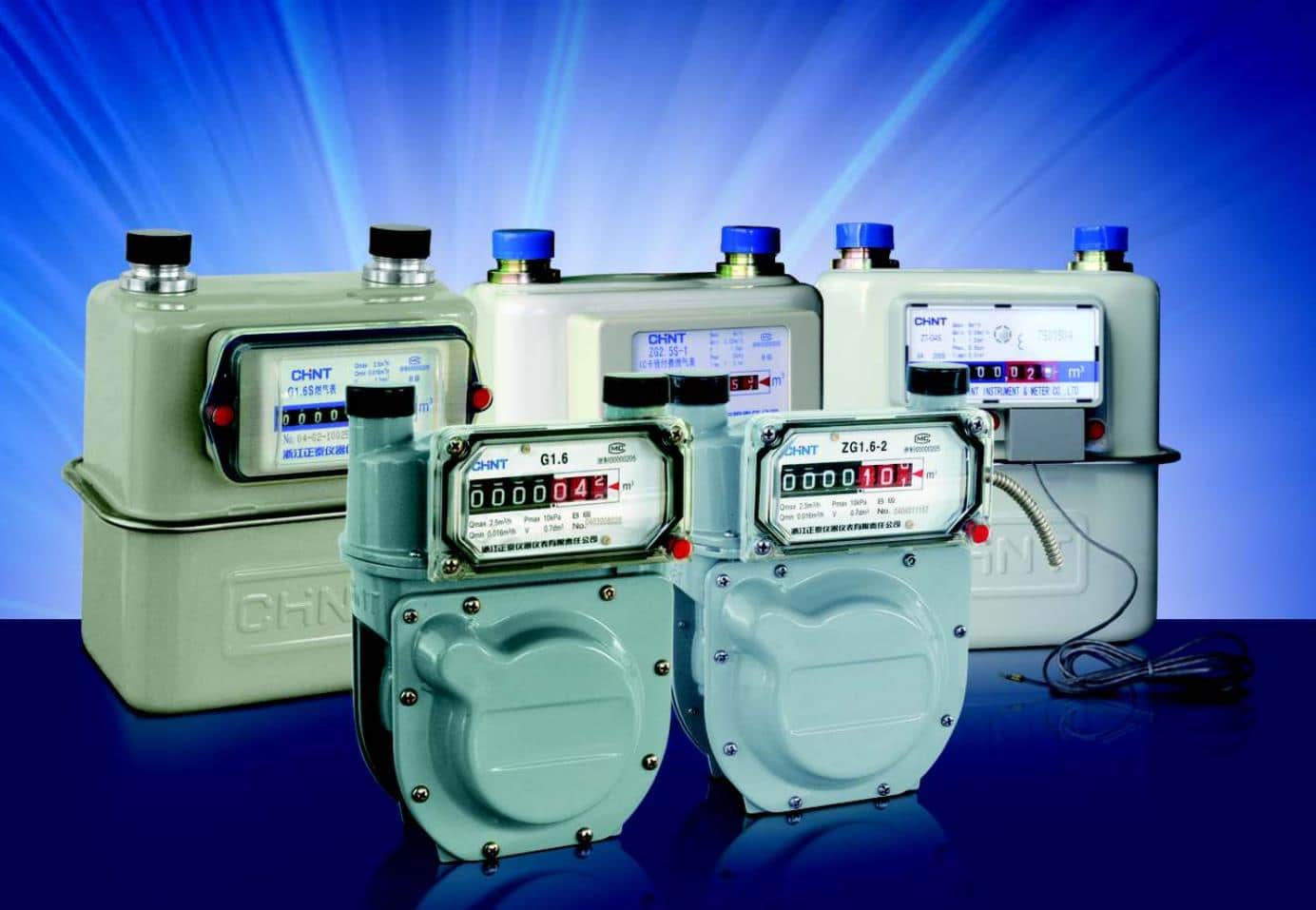
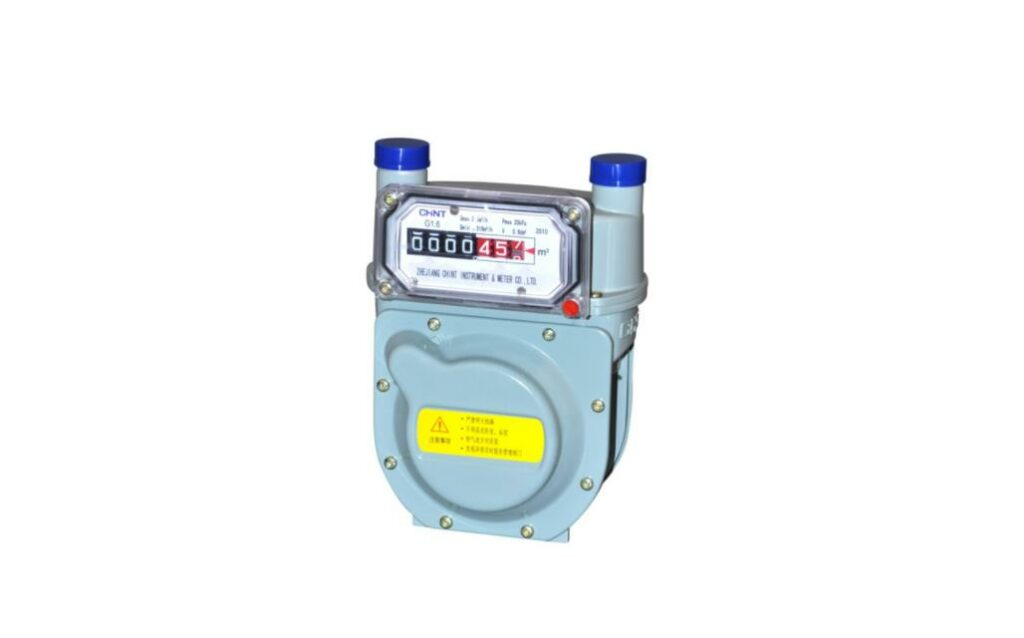
CHINT diaphragm gas meter
CHINT is one of the few diaphragm gas meter manufacturers that market a very wide variety of diaphragm gas meters with “smart” functionalities (internet-of-things gas meters) and IC cards implemented to transmit data regarding gas flow and meter status.
Chint devices are able to surpass 8000 hours in durability and have EN 1359, OIML R 137, and MID certifications, meaning that they comply with international measurement standards.
Their “smarter” line of diaphragm gas meters comes with visual and voice alarms, letting users know whenever the remainder gas is below critical levels or the device is experiencing a malfunction.
These are some of their most relevant offerings:
- G1.6, G2.5 Aluminum Case Gas Meter: Measures natural gas, city pipe gas, marsh gas, liquid gas, and other similar gas types with a working pressure ranging from 0.5 ~ 20 kPa.
- G1.6S, G2.5S, G4S Steel Case Gas Meter: Measures natural gas, city pipe gas, marsh gas, liquid gas, and other similar gas types with a working pressure ranging from 0.5 ~ 50 kPa.
- ZG1.6S-2, ZG2.5S-2, ZG4S-2 (Steel) Wireless Remote Diaphragm Gas Meter: This one, as the name might give out, has wireless functionality for data transmission and remote control.
Conclusion
We would conclude this guide by emphasizing the importance of knowing how gas meters work, from the moment they’re turned on to the moment that gas enters our appliances, as well as the relevance of choosing the correct type of gas meter.
In that regard, if you are a heavy gas user or own a large-scale company that utilizes copious amounts of gas-powered equipment, you’d do well in considering an upgrade to the rotary meter system. However, if you’re a small house or business owner, you would fare better with diaphragm gas meters such as the ones offered by CHINT.