Please enter keywords to search

Global |EN

Choose your country & Language

Asia Pacific

Australia & New Zealand
India
Indonesia
Malaysia
Philippines
Singapore
Vietnam

Middle East & Africa

CHINT-EGEMAC
Saudi Arabia
South Africa
UAE
Egypt
Kenya

Europe

France
Italy
Spain
Turkey
Kazakhstan
Netherlands

North America

Mexico
USA
Canada

Latin America

Brazil
Peru
Ecuador

Choose your country & Language

Australia & New Zealand
India
Indonesia
Malaysia
Philippines
Singapore
Vietnam
CHINT-EGEMAC
Saudi Arabia
South Africa
UAE
Egypt
Kenya
France
Italy
Spain
Turkey
Kazakhstan
Netherlands
Mexico
USA
Canada
Brazil
Peru
Ecuador

Please enter keywords to search

Your search term contains restricted words. Please use different keywords.

Will Renewable Energy be the Dominant Market in Future For Cost?

AUG 29, 2021

China is the country with the highest CO2 emissions in the world and it is also the country that adds the most renewable energy sources each year. According to the XIV Five-Year Plan, we cannot only understand the importance of my country’s commitment to carbon neutrality, but it will also determine my country’s development path as the world’s largest market for renewable energies in the years to come. 

Because of their low cost, fossil fuels have dominated the global energy industry for along time. Along the way, fossil fuels are much cheaper than other types of energy. Influenced by this crucial factor, if you want to move to renewable energy as the dominant position, the cost of fossil fuels is the real comparison.
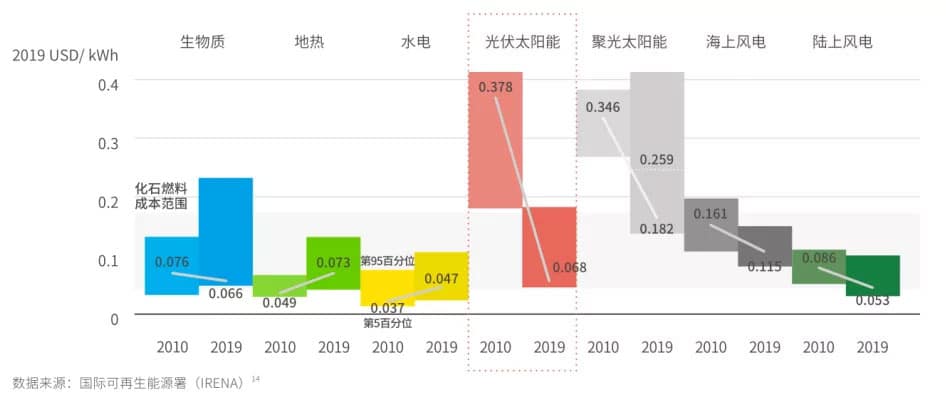
Ten years ago a fossil-fuel power plant was still significantly cheaper than a solar photovoltaic power plant or a wind power plant, but the situation has changed completely in the last few years. According to the International Renewable Energy Agency (IRENA) “2019 Renewable Energy Power Generation Costs”, the worldwide costs for photovoltaic kilowatt hours again reached a new low in 2019 at around 0.068 US dollars / kWh. 

From 2010 to 2019, the global cost of PV kilowatt hours decreased by 80%, while in 2019 it decreased by 13% compared to the previous year. The wind and solar capacities have grown rapidly in recent years; In 2019, renewables accounted for 72% of new global capacity.

Why is the cost of renewable energy decreasing so fast?

The cost of fossil fuels depends essentially on two factors, namely the fuel price and the operating costs of the power plant itself; It is different with renewable power plants: the operating costs are lower and no auxiliary fuel is required, which significantly determines the costs of renewable energies. It is the technology itself. 

Currently, the vigorous expansion of renewable energies has become a worldwide consensus. The International Renewable Energy Agency (IRENA) anticipates the development of renewable energies and assumes that renewable energy will account for 90% of electricity generation by 2050. It is predicted that the cost per kilowatt hour of global utility-scale photovoltaic power plants will reach 0.02 to 0.08
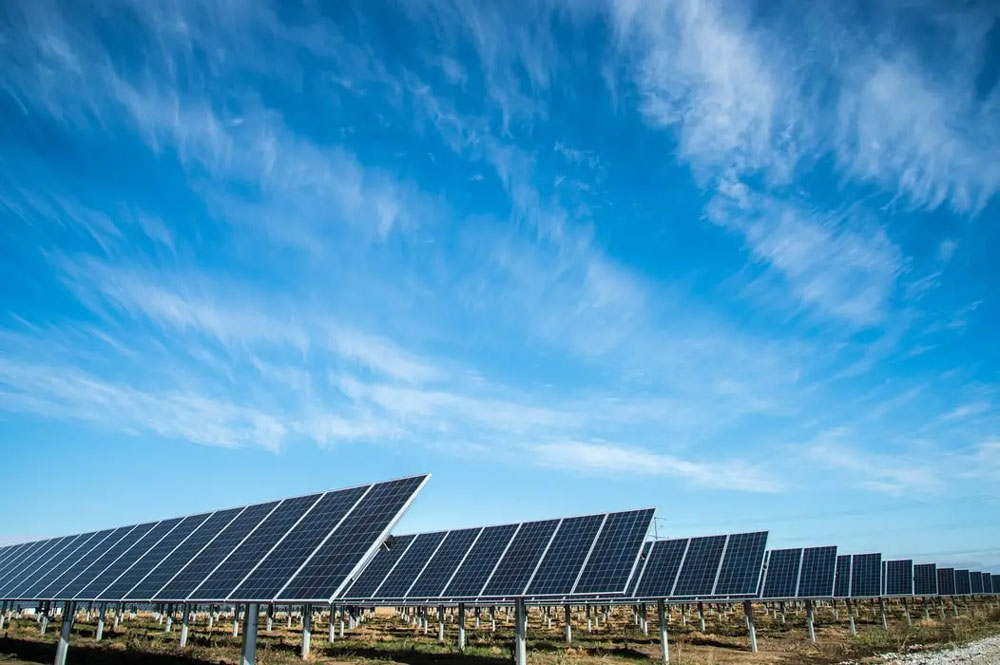
As the average cost of renewable energy projects declines, the growth rate of new photovoltaic energy sources is expected to outpace that of wind energy. In the next 10 to 20 years, photovoltaic projects will be the most direct way to meet carbon neutral commitments worldwide due to the lower costs per kilowatt hour of photovoltaics.

The Latest
DECEMBER 25, 2025 CHINT Enhances EV Charging Safety with Advanced Protection Solution in France

CHINT boosts EV charging safety in France with protection solutions, raising short-circuit capacity to 30kA while cutting costs.

DECEMBER 23, 2025 Did you know - CHINT MCBs Deliver Compact Design with Global-Scale Performance

CHINT MCBs combine compact design with globally certified performance, delivering reliable safety and consistent quality for residential, commercial, and industrial use.

DECEMBER 4, 2025 CHINT Repeats Honor: Listed on The Watchlist 2026 as ESG Champion

CHINT Group is named an ESG Champion at Bloomberg Green’s Watchlist 2026, highlighting its innovation, clean energy achievements, and leadership in China’s green transition.

OCTOBER 11, 2025 CHINT Powers a Greener Future at Vietnamese International School

CHINT empowers a Vietnamese international school with an 86kWp solar rooftop system, cutting CO₂ emissions and inspiring eco-conscious education.

OCTOBER 11, 2025 Did you Know CHINT? When Manufacturing Meets ESG

Discover how CHINT leads sustainable manufacturing through ESG—advancing green factories, people-focused initiatives, and responsible governance.

SEPTEMBER 23, 2025 CHINT Signs MoU with Prince Sattam bin Abdulaziz University to Advance Smart Energy Research and Innovation

CHINT signs MoU with Prince Sattam bin Abdulaziz University to drive smart energy research, innovation, and sustainable solutions in Saudi Arabia’s Vision 2030.

SEPTEMBER 19, 2025 Lighting Up the Rooftop of Africa: CHINT Anneng’s Journey of Light and Hope

CHINT Anneng’s PVSTAR brings clean solar power to Kenya, lighting homes, powering shops, and driving Africa’s green, sustainable future.

SEPTEMBER 9, 2025 CHINT Electric Earns EcoVadis Gold, Making a Leap from Bronze to Gold in One Year

CHINT Electric earns EcoVadis Gold Medal, up from Bronze in a year—top 5% globally for Environment, Labor & Human Rights, Ethics and Sustainable Procurement.

SEPTEMBER 9, 2025 CHINT Semi-Annual Report of 2025

CHINT 2025 Semi-Annual Report: H1 revenue $4.14B (+2.2%) and net profit +32.9%, led by smart electrics, green energy, and global expansion. Released Aug 27.

AUGUST 29, 2025 CHINT Colombia: The evolution of a commitment to the energy of the future

CHINT Colombia opens its Bogotá office to boost innovation, clean energy, and sustainable growth, driving the country’s energy transition.