


Table of Contents |
An arc fault circuit breaker (AFCB) or arc fault detection device (AFDD) is designed to detect faults in the connections of an electrical installation capable of causing a fire.
These devices can shut off the flow of electricity when they detect the presence of a dangerous electrical arc, so they have become essential devices in homes and businesses to guarantee their safety when these electrical failures occur.
Why Were Arc Fault Circuit Breakers Created?
AFCBs originated in the 90s as a response to a serious problem present in the electrical installations of a large number of homes.
According to reports at the time by the U.S. Consumer Product Safety Commission and, more recently, by the National Fire Protection Association, a large number of fires are caused each year by electrical failures.
In fact, current statistics estimate an average of around 400 civilian deaths, 1,300 civilian injuries, and more than $1.4 billion in property damage each year as a direct result of these fires.
By the end of the 90s, installing AFCB devices became a mandatory requirement in the National Electrical Code (NEC) to guarantee the safety of electrical installations and help protect homes and businesses against these hazards.
How Do Arc Fault Circuit Breakers Work?
Electric arcs occur naturally in household appliances at certain stages of their operation. This happens even when you turn off a light switch.
What an arc fault circuit breaker does is monitor the electrical flow to detect the presence of unusual arcing conditions.
This is possible because AFCBs have small filters and logic circuits that act as intelligent instruments that enable the breaker to detect the slightest change in the electrical flow.
When an AFCB detects unusual arcing activity in the circuit, it immediately cuts off the flow of electricity to prevent a dangerous arc, which could easily cause a fire.
This is different from how standard circuit breakers work since these aren’t designed to detect arcs but to protect the electrical installation against large current leakages.
These devices ensure that the flow of current from the source to any home appliance is uninterrupted. If the breaker detects any disturbance in the current flow, it opens the circuit to prevent any possible damage.
That’s why you should have AFCBs in the electrical installations of your home or business since they contribute to increasing electrical safety in general.
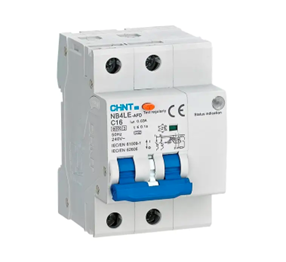
A good example is the CHINT NB4LE-AFD model, which can provide overload, short circuit, leakage protection, and arc fault detection as needed.
Why are Traditional Circuit Breakers Inadequate?
Typically, electrical arcs that form in household circuits are small fluctuations in the electrical flow that differ from large current flows that go to the ground. However, these small current flows can generate enough heat to ignite surrounding wood or plastic.
The problem with standard circuit breakers is that they aren’t designed to detect these small current fluctuations, but large energy flows are generated when a fault such as a short circuit occurs.
In this way, a traditional circuit breaker is inefficient against the formation of small and subtle electrical arcs, so they cannot offer protection in many circumstances in which there is a fire risk.
How an Arc Fault Circuit Breaker Works?
An arc fault circuit breaker can detect different arcing events thanks to the sensor technology integrated into the device.
Although there are different types of technologies integrated into AFCBs, depending on the manufacturing company, all these devices are capable of detecting two types of arcs:
- Parallel arcs – These can be line-to-line, line-to-neutral, and line-to-ground arcs.
- Series arcs – Arcs that occur in series on the same electrical conductor.
Basically, AFCBs can detect whether an electric arc is normal or dangerous thanks to this set of electronic sensors.
As mentioned, there are many electrical devices in homes and businesses that generate electrical arcs. However, sometimes these electric arcs can also occur when there is some type of damage to the wiring or even to the circuit itself in the structure of the enclosure (for example, damage to the insulation of a cable).
AFCBs are constantly analyzing the condition of these arcs to determine if they are safe or dangerous since these devices can operate in a certain range of variations in the electrical flow, depending on the device’s features.
In addition, AFCBs are suitable for any 15A or 20A branch circuit, and their installation in any room is relatively easy since it is enough to follow the instructions indicated by the manufacturer. In general, it is only necessary to connect the hot and neutral conductors to the proper terminals of the arc circuit breaker.
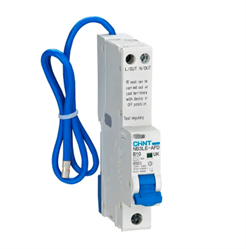
The CHINT NB3LE-AFD model, an arc fault detection circuit breaker with a residual current operated function that operates at a frequency of 50 Hz and a rated voltage of 240 volts, is another good example of the advanced features available in modern AFCBs.
This model can also provide overload, short circuit, leakage protection, and arc fault detection, but it can also be used for infrequent switching of the circuit under normal circumstances.
Related Article: How Arc Fault Circuit Breakers Protect Your Family and Property
NEC Requirements and Arc Fault Circuit Breakers Code
AFCBs have evolved over the years to become an essential element in electrical installations in modern homes and businesses since they have the potential to prevent fires and save lives.
For this reason, between 1999 and 2002, the National Electric Code (NEC) created an arc fault circuit breaker code to ensure that AFCB devices were included in the electrical circuits of the bedrooms of each home since these were considered the main source of fire generation by electric arcs.
However, starting in 2008, an update to the NEC code began to require a greater presence of these devices in household electrical installations.
At first, the installation of AFCBs was required in some residential circuits, excluding some important areas such as laundry rooms and kitchens. However, as of 2014, due to the increase in electronic devices in homes, a new update now requires a greater presence of AFCBs.
While the NEC code only requires the presence of traditional circuit breakers in outlets outside the house starting from a 150-volt supply, the regulation requires arc fault detection devices to be included in every living area. Additionally, AFCBs must also be present in rooms of schools and hotels and in any area that includes permanent electrical cooking appliances.
Conclusion
Arc fault circuit breakers are devices that can prevent the appearance of dangerous electrical arcs capable of causing fires so that you can see them as a kind of life insurance in your home or business. Additionally, they are also cheap and easy to install.
In this way, replacing traditional circuit breakers with AFCBs can make the difference between having your family protected or unprotected from potential electrical hazards.
CHINT Global has everything you need to guarantee your safety. To learn more about our AFCB products, contact us today or browse our website for information.